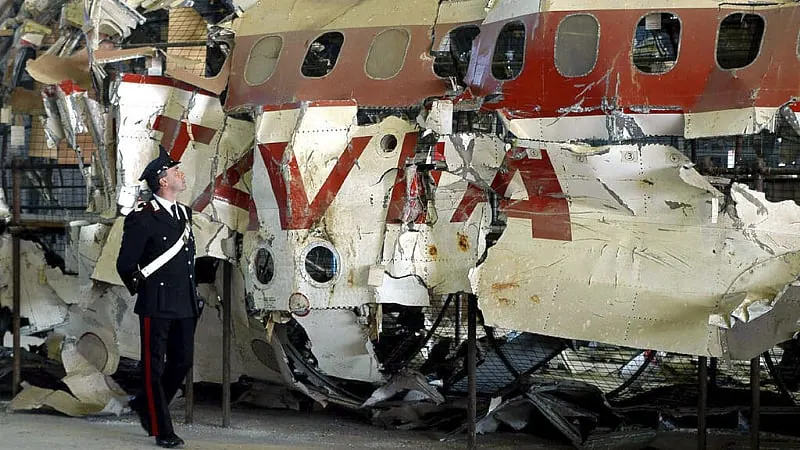
The island of Ustica, a rocky outpost in the Tyrrhenian Sea, is known for its dark rock formations and a notorious plane crash that claimed 81 lives. Itavia Flight 870, which crashed on June 27, 1980, remains a subject of debate after decades of investigations. The most widely accepted theory suggests the plane was caught in an aerial dogfight and mistakenly shot down by a fighter jet, possibly French.
News that French authorities will hand over defence documents to Italian investigators has raised hopes of solving the mystery. Prosecutors had planned to shelve the latest investigation, but the new evidence has led them to continue the probe. The DC-9 plane, operated by Itavia, broke up and crashed into the sea while en route from Bologna to Palermo, killing all 77 passengers and 4 crew members.
The incident, known as the strage di Ustica, has contributed to the erosion of trust between citizens and institutions in Italy. Historian Cora Ranci, who has written a book on the Ustica affair, says the cover-up has hampered investigations and fueled the sense of secrecy surrounding the case. The reconstructed wreckage and recovered items are currently stored in a hangar near Rome.
Following the crash, officials concluded that mechanical failure was the cause, leading to the demise of Itavia. However, judicial inquiries resumed years later, spurred by an investigative journalist who believed the plane had been shot down. Four air force generals were tried on charges of treason and withholding evidence, but none were convicted.
At least 15 military personnel and others connected to the case have died under mysterious circumstances, further muddying the waters. In 2013, Italy's highest court ruled that the plane had been brought down in an aerial battle, either by a missile or near-collision, without identifying a culprit. The state was ordered to compensate families of the victims.
Despite court rulings, some remain skeptical of the missile scenario, suggesting a bomb on board the plane. Potential culprits include far-right activists, Palestinian militant groups, and Muammar Gaddafi's Libya. The Libyan strongman is also linked to the missile hypothesis, which gained traction in 2007 when former Italian president Francesco Cossiga claimed French military planes shot down the passenger jet.
Proponents of the Libyan link point to the recovery of a Libyan MiG fighter on a mountain in Calabria, which may have been chased and downed on the same night as the DC-9. Declassified documents reveal Italy allowed Libyan aircraft to fly through its airspace, infuriating the Americans and French, who were fighting a proxy war with Gaddafi's Libya in Chad.
Key points
- French defence documents may shed light on the 1980 plane crash that killed 81 people
- The Italian government has been accused of withholding evidence and covering up the incident
- Multiple theories surround the crash, including a missile, near-collision, or bomb on board the plane