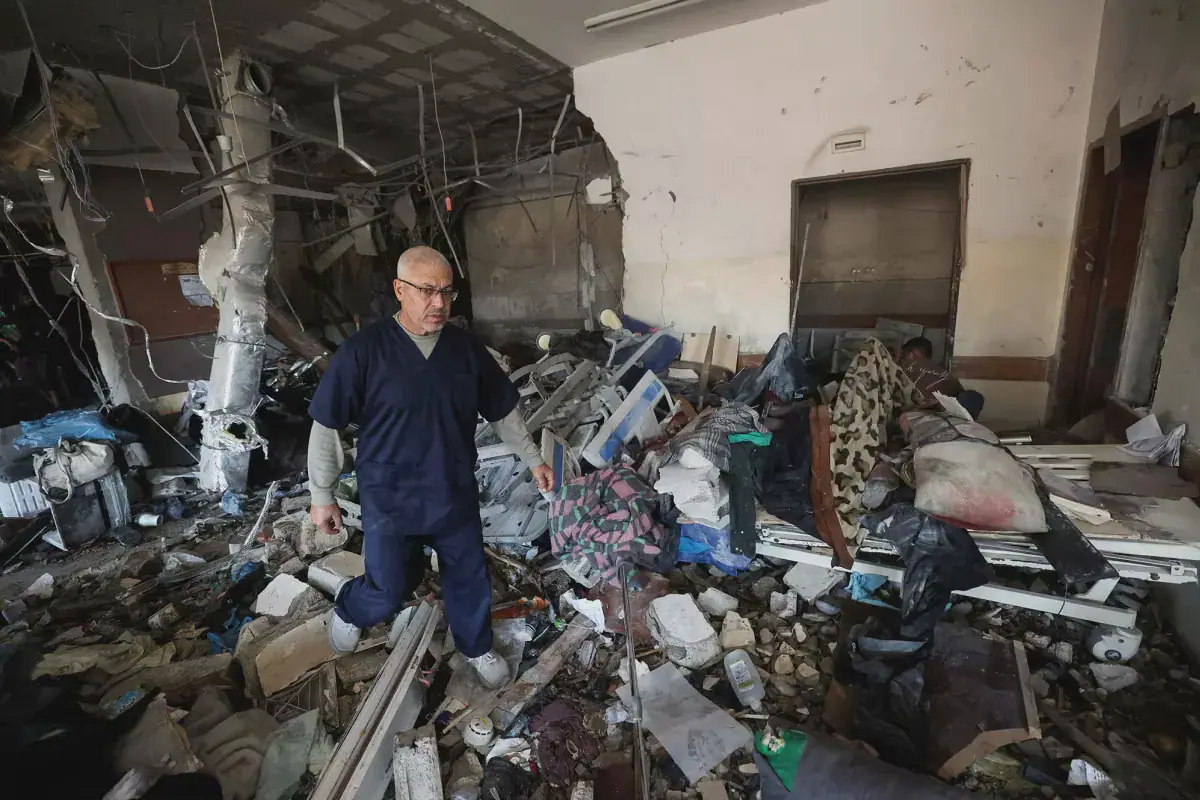
An Israeli airstrike on Nasser Hospital in southern Gaza overnight Wednesday resulted in the deaths of at least six people, including a doctor and a child, according to Palestinian officials. The strike, which occurred shortly after midnight, targeted the hospital's surgery unit, causing significant damage and leaving charred debris scattered across the destroyed unit. Gaza Civil Defense spokesman Ezz Eddine Abu Sabha reported that the attack killed 52-year-old Dr. Rizk Abu Shaira and a 13-year-old boy who was scheduled to undergo surgery.
The Israeli strike on Nasser Hospital injured 40 people, including two doctors who are in critical condition. The attack has been widely condemned, with many questioning the existence of a ceasefire. Maryam Abu Hatab, whose brother was killed in the strike, expressed her outrage, saying, "They say there is a ceasefire. Where is there a ceasefire? Since the ceasefire, there are more massacres." The situation in Gaza remains dire, with nearly two million Palestinians displaced and living in tents that are vulnerable to flooding.
Footage from inside the hospital showed two bombs, one of which failed to explode, with a label identifying it as a US-manufactured GBU-39/B, a 250-pound bomb that has been supplied to Israel. The use of such munitions has raised concerns about the impact on civilians in Gaza. A patient at the hospital, Atiya Abu Basir, described the terrifying experience, saying, "I was asleep when suddenly I was covered with dust and glass. I couldn’t walk because I just had surgery."
The Israeli Defense Forces (IDF) claimed that the airstrike targeted the commander of Hamas' Khan Younis Brigade, Muhammad Abu Ismail, and other terrorists hiding inside the hospital. The IDF stated that Abu Ismail planned and advanced attacks on Israeli forces and civilians. However, it is unclear if Abu Ismail was killed in the strike, and the IDF has not provided details on measures taken to reduce the risk to civilians.
The situation in Gaza is further complicated by the ongoing flooding, which has swamped tens of thousands of tents across the coastal enclave. The US-led Board of Peace has criticized Israel for its response to the flooding, calling it "insufficient." The board has urged Israel to allow the entry of essential supplies, including shelter, sanitation, and drainage equipment, to protect civilians.
According to the United Nations, Israeli forces have killed more than 1,400 people in Gaza since the ceasefire, and there is no fully functioning hospital in the devastated enclave. The reconstruction of Gaza is hindered by Israel's refusal to allow in heavy equipment needed for large-scale cleanup and rubble removal efforts. Israel's Coordinator for Government Activities in the Territories stated that reconstruction can only begin after Hamas fully disarms.
The international community remains concerned about the humanitarian crisis in Gaza, with many calling for an end to the violence and the protection of civilians. The Israeli-Palestinian conflict continues to be a major challenge, with a lasting resolution yet to be achieved. The incident at Nasser Hospital has highlighted the need for urgent action to address the humanitarian crisis and prevent further loss of life.
Key points
- The Israeli airstrike on Nasser Hospital in Gaza has killed six people, including a doctor and a child, and injured 40 others.
- The strike has been widely condemned, with many questioning the existence of a ceasefire.
- The situation in Gaza remains dire, with nearly two million Palestinians displaced and living in vulnerable conditions.