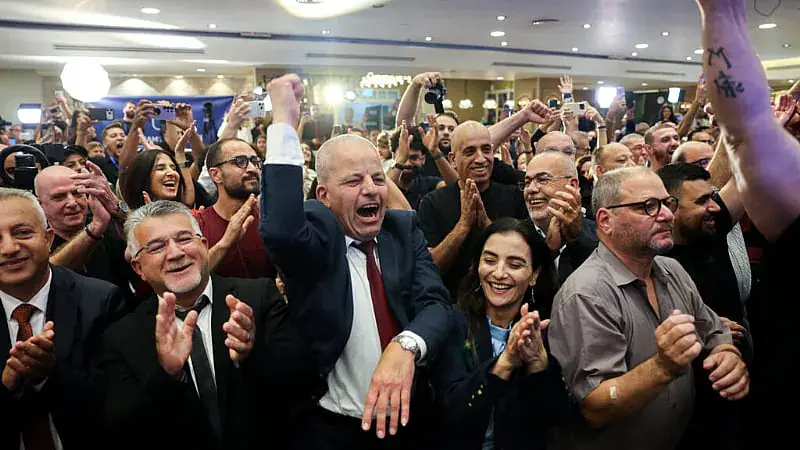
Israel's recent election has left the country's political landscape uncertain, with neither of the two main frontrunners, Benjamin Netanyahu and Gadi Eisenkot, securing a parliamentary majority. With over 85 percent of the votes counted, Netanyahu's Likud party and Eisenkot's "Change" bloc are hovering around 53 percent and 50 percent respectively. However, the biggest surprise of the election came from Israel's Arab parties, the Joint List and Ra'am, which are projected to send 19 lawmakers to parliament.
The Arab parties' success is significant, given that Arab Israelis, who make up around 21 percent of the population, typically record a much lower voter turnout than other Israelis. In the 2022 election, the Arab bloc won just 10 seats. The high voter turnout of over 77 percent, the highest in almost three decades, has been attributed to the growing concern among Arab Israelis about the situation in Gaza and the occupied West Bank. According to Sylvaine Bulle, an expert on Israel and the Israeli-Palestinian conflict, the Arab Israelis have "woken up" and are now seeking to translate their electoral power into an influential political force.
The leader of Ra'am, Mansour Abbas, expressed his party's excitement about the results, saying that they would "translate this electoral power into an influential political force" and that they were "here – not on the sidelines." The Joint List and Ra'am parties are now in a position to potentially hold the key to forming a government, with Eisenkot seen as a possible partner. However, Netanyahu has warned Eisenkot against working with the Arab parties, saying that it would "endanger Israel and establish a government that relies on anti-Zionist Arab parties."
Despite Netanyahu's warning, Eisenkot may find it difficult to join forces with the Arab parties, particularly the Joint List, which is an alliance of Arab nationalist and left-wing parties. Eisenkot has laid down four conditions for cooperation, including recognising Israel as a Jewish and democratic state and denouncing Hamas as a terrorist group. However, Amjad Shbita, the head of the biggest party in the Joint List coalition, has said that Eisenkot is in no position to dictate the terms of a potential cooperation and that they would negotiate as equals.
The possibility of Eisenkot forming a minority government with the support of the Arab parties has also been raised. However, this would require delicate negotiations and an agreement on a common political programme, potentially including the end of the occupation of the West Bank. According to Bulle, it would be complicated to form a government with the Arab parties, and it would require a lot of work to find common ground.
The calls for Eisenkot to open up more to the Arab parties in a bid to oust Netanyahu have already begun. Yair Golan, the head of Israel's main left-wing party, has said that they must no longer accept Netanyahu's racist division between Jewish voters and Arab voters and that they have a responsibility to form a government of change in partnership with Israel's Arab citizens.
The final results of the election are still pending, and both sides face the challenge of cobbling together a majority or at least a viable minority government. The Arab parties' success has added a new dynamic to the Israeli political landscape, and it remains to be seen how their influence will shape the country's future government.
Key points
- Arab parties see historic gains in election, potentially holding the key to forming a government.
- High voter turnout among Arab Israelis contributes to their success.
- Netanyahu warns Eisenkot against working with Arab parties.