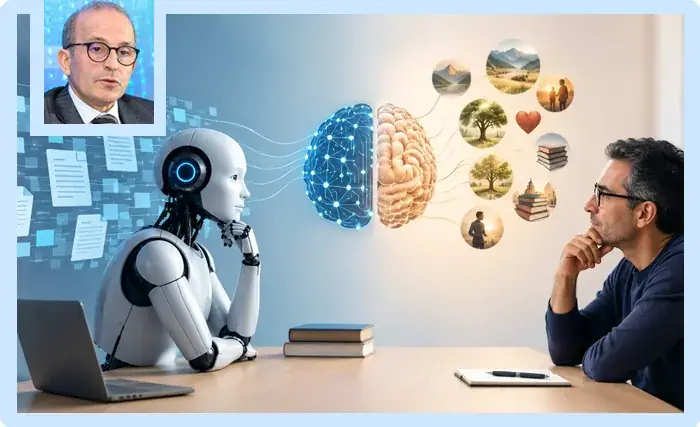
The rapid development of generative AI, particularly Large Language Models (LLMs), has left users amazed by their ability to generate intelligent text and engage in conversations that seem almost human-like. However, the question remains as to whether these AI systems truly comprehend the text they produce and the requests made of them. This issue was recently discussed at a conference held at the University of Tunis, where the author presented a nuanced view on the matter.
The concept of understanding is complex and multifaceted, and it is essential to define what we mean by "understanding" when it comes to AI. A simple definition is that understanding involves grasping relationships and being able to apply them in a relevant manner. This can include linking cause and effect, word and situation, or rule and conditions of application. The author suggests that understanding is not just about providing correct responses but also about being able to explain, transfer knowledge, and recognize the limits of one's understanding.
Linguists Emily Bender and Alexander Koller argue that a system trained solely on the form of language does not have the capacity to access meaning. They distinguish between mastering linguistic regularities and understanding the meaning of statements in a communication situation. For instance, the phrase "It's cold here" can express a statement, a complaint, or an indirect request to close a window. Understanding this phrase requires not only knowledge of the words but also the context in which it is being used.
The debate on AI understanding dates back to 1980, when philosopher John Searle proposed the thought experiment of the "Chinese Room." A person who does not speak Chinese receives messages in Chinese and, using instructions, produces responses without understanding the meaning. Searle argues that manipulating symbols correctly is not enough to comprehend their meaning, highlighting the difference between syntax and semantics.
Searle's argument is centered on the distinction between syntax, semantics, and intentionality. He claims that a program provides only syntax, while semantics and intentionality require biological causes specific to the brain. While his argument is influential, it is not conclusive, and critics argue that the person in the Chinese Room is not the entire system, and perhaps the combination of instructions, memory, and operations possesses a capacity that individual elements do not.
The question of AI understanding remains a topic of discussion, with some arguing that AI can simulate understanding but not truly possess it. Others propose that understanding may be a matter of degree, and AI systems can be designed to improve their comprehension capabilities. The author's conclusion is that it is essential to avoid two extremes: attributing human-like qualities to machines because they communicate effectively, and denying them any form of understanding because their functioning differs from ours.
Ultimately, the issue of AI understanding has significant implications for our understanding of language, knowledge, and the mind. As AI continues to evolve, it is crucial to examine the limits of its capabilities and the nature of its "understanding." By exploring these questions, we can gain a deeper understanding of the potential and limitations of AI and its role in human communication.
Key points
- AI systems may not truly comprehend the text they produce and the requests made of them, despite their ability to generate intelligent responses.
- The concept of understanding is complex and multifaceted, and it is essential to define what we mean by "understanding" when it comes to AI.
- The debate on AI understanding highlights the need to avoid two extremes: attributing human-like qualities to machines and denying them any form of understanding.