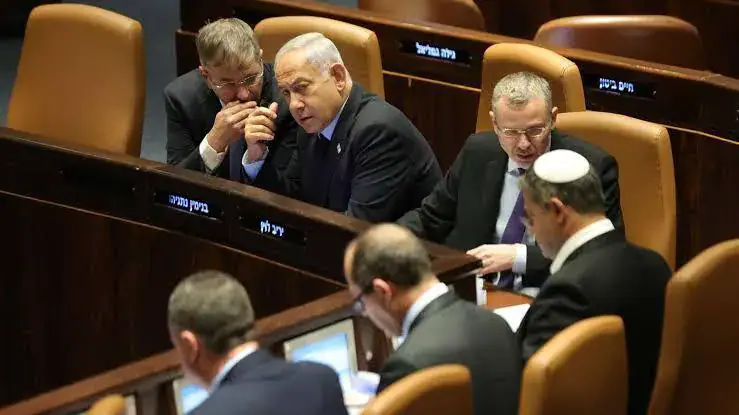
The recent Israeli elections have ended in a stalemate, with neither Benjamin Netanyahu's Likud party nor Gadi Eisenkot's Yashar party securing a majority. As of Wednesday, October 28, with nearly 92% of votes counted, Netanyahu's bloc had 53 seats, while Eisenkot's had 48, out of 120 parliamentary seats. This impasse is likely to lead to a new round of voting.
The main obstacle to forming a government is the refusal of both Netanyahu and Eisenkot to include Arab parties in their coalition. These parties, with 19% of the vote, are crucial to securing a majority. However, both leaders, ideologically aligned with the extreme right, are hesitant to integrate them into their government. Analyst Elijah Magnier notes that the remaining 600,000 votes to be counted are unlikely to change the outcome significantly.
This is not Israel's first experience with electoral impasse. Between 2018 and 2021, the country held three consecutive elections before a government could be formed through a complex coalition of interests. The current situation may lead to another round of voting, with President Isaac Herzog likely to call new elections in the coming weeks.
Despite the impasse, Netanyahu may try to delay new elections by convincing his ally, Donald Trump, to launch a new wave of attacks against Iran, which Israel would likely join. This would create a state of war, allowing Netanyahu to postpone elections. This scenario is not new, having occurred four times in the past, including in 2023 and 1982.
Netanyahu's motivation for maintaining power is to avoid facing corruption, abuse of power, and money laundering charges. As long as he remains in office, he is shielded from prosecution. His ability to maintain power has allowed him to evade justice for 19 years.
However, there may be an opportunity for Eisenkot to change his stance. Some leaders of smaller parties supporting him, such as Yoar Golan, have expressed willingness to negotiate with Arab parties to form a coalition government. This could potentially break the impasse and lead to a more inclusive government.
The outcome of the elections has significant implications for Israel's future. With no clear majority and deep divisions between parties, forming a government will require compromise and negotiation. The international community is watching closely, as Israel's stability has far-reaching consequences for the region.
Key points
- Netanyahu and Eisenkot refuse to form alliances with Arab parties, leading to an electoral impasse.
- The impasse may lead to a new round of voting, with President Herzog likely to call new elections.
- Netanyahu's motivation for maintaining power is to avoid facing corruption charges.