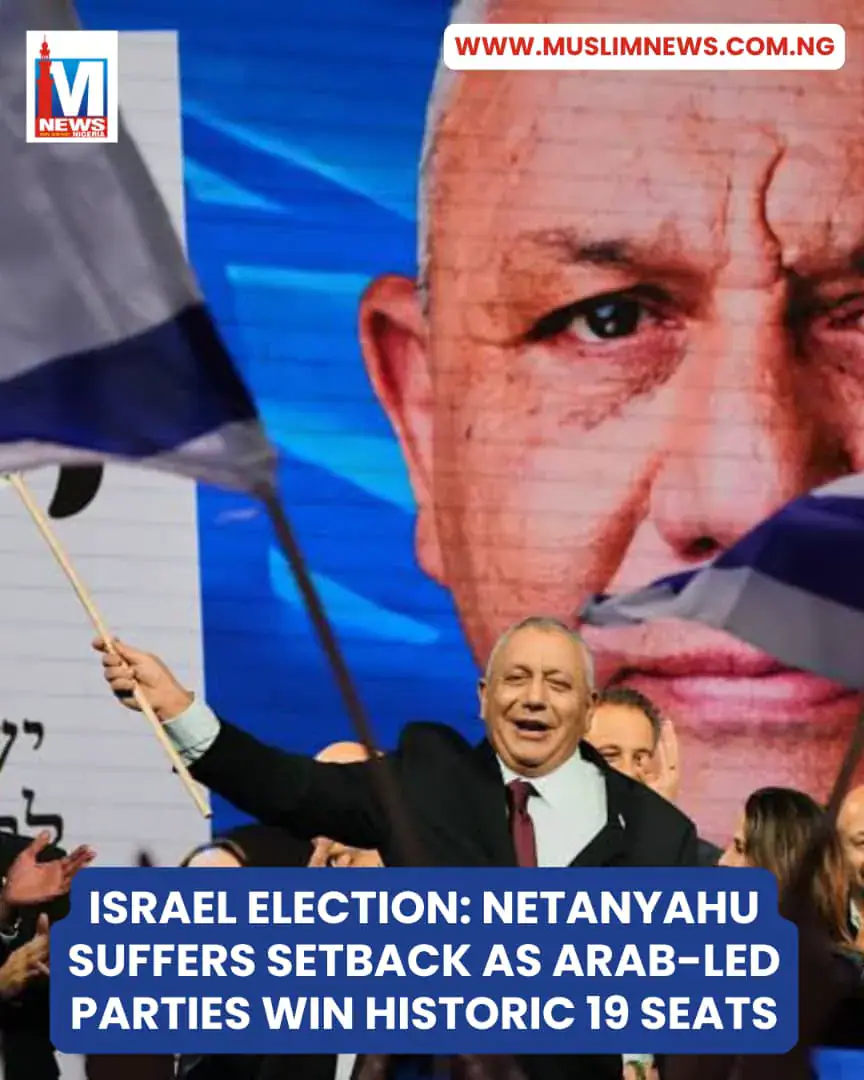
Israel's October 27, 2026 general election has left the country facing another period of political uncertainty, with no political bloc securing the 61 seats required to form a government in the 120-member Knesset. Results released by the Central Elections Committee after the vote count was completed on Friday, October 30, showed that Netanyahu's bloc secured 53 seats, while the opposition bloc led by former military chief Gadi Eisenkot won 48. This development has raised questions about who will form the next government.
The Arab-led parties won a combined 19 seats, giving them a potentially decisive role in determining who forms the next government. The Joint List won 11 seats, while Ra'am, led by Mansour Abbas, secured eight. Their combined representation gives Arab political leaders greater potential influence in the formation of the next government, although the two parties have different political approaches and are not necessarily expected to act as a single bloc.
The gains are particularly significant because Palestinian citizens of Israel, who make up about one-fifth of the country's population of approximately 10 million, have long faced political and social challenges, including discrimination, inadequate infrastructure, housing difficulties and rising crime. The 19 lawmakers represent Palestinian citizens of Israel, who hold Israeli citizenship and participate in the country's elections.
Following the 1948 Arab-Israeli war and the bloody establishment of Israel on Palestinian land, hundreds of thousands of Palestinians fled or were expelled from their homes in an event known as An-Nakba (the Catastrophe). Those who remained within the territory that became Israel, estimated at about 150,000, became the Palestinian Arab minority in the new state. Under Israel's 1952 Nationality Law, many of them and their descendants acquired Israeli citizenship.
The arithmetic suggests that an opposition government could potentially reach the required majority if it secured the support of the 19 lawmakers from the Arab-led parties. However, forming such an alliance will not be straightforward. Eisenkot's opposition camp includes parties whose leaders have expressed reservations about relying on Arab parties to form a government.
The election has also been followed by controversy over allegations of foreign interference and irregularities involving Arab voters. Netanyahu and his political allies raised allegations of possible foreign funding and interference, including claims involving Qatar and Türkiye. However, these allegations have not established that the election results were manipulated.
The election was Israel's first general election since the October 7, 2023 Hamas-led attacks and the subsequent Israel's genocidal war on Gaza. The attacks, the failure of Israel's security establishment to prevent them, the fate of Israeli captives and the prolonged war in Gaza have shaped the wider political debate. Netanyahu's opponents have criticised his government's handling of the security crisis and called for accountability over the failures surrounding October 7.
Key points
- Arab-led parties won a combined 19 seats in the Israeli general election.
- The opposition bloc led by Gadi Eisenkot won 48 seats.
- Netanyahu's bloc secured 53 seats but fell short of a parliamentary majority.