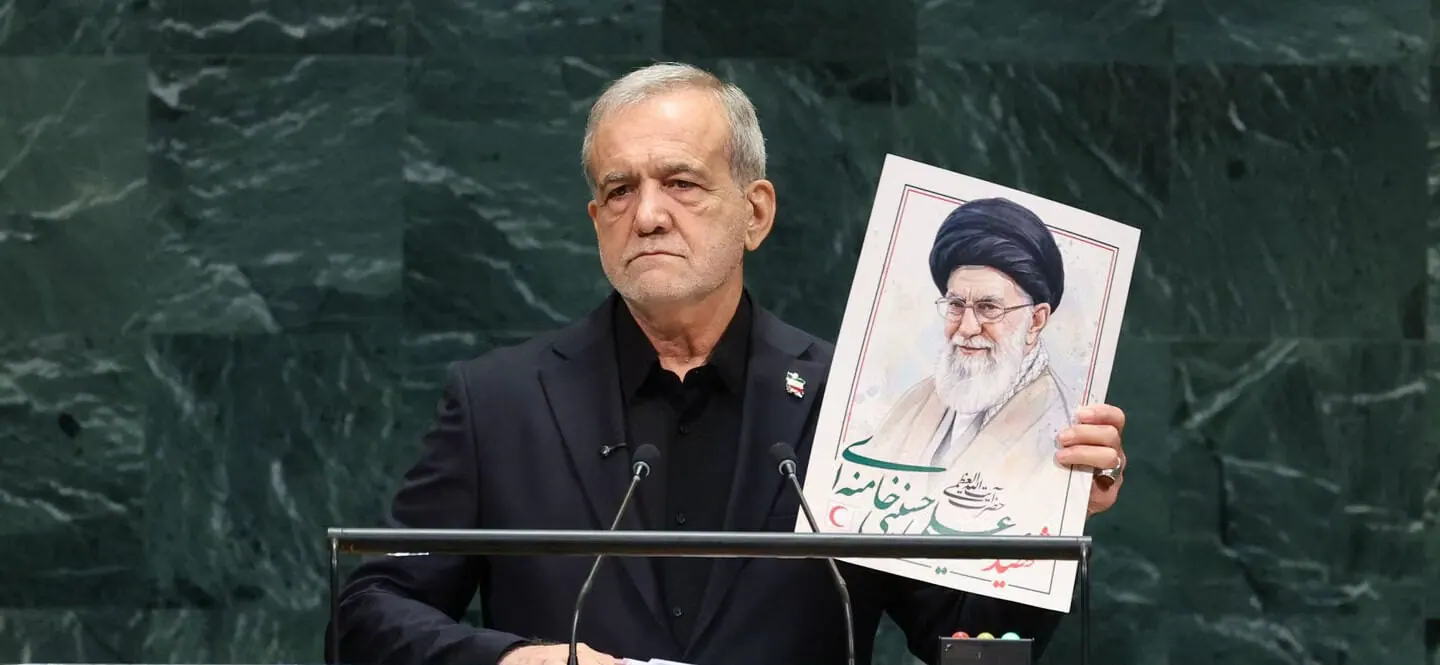
Iranian President Massoud Pezeshkian addressed the UN General Assembly on Wednesday, stating that his country remains open to dialogue and diplomacy but will not be intimidated. This comes in response to US President Donald Trump's threat of annihilation the previous day. Pezeshkian emphasized Iran's willingness to engage in negotiations without resorting to or accepting the use of force.
During his speech, Pezeshkian presented photographs of children killed in a school strike in Minab, highlighting that Iran has been a victim of terrorism. He described Iran's military capabilities as purely defensive. The Iranian president also touched on the nuclear issue, rejecting the idea that mastery of this technology should be exclusive to certain nations. He stressed that the dispute cannot be resolved through military means.
Pezeshkian warned that no country in the region will achieve security in isolation, a statement aimed at both Gulf states and external powers. The US delegation left the room during his address. US Secretary of State Marco Rubio later criticized Iran's human rights record and characterized the ongoing diplomatic exchanges as merely a continuation of previous conversations.
Both sides describe these talks as preliminary, with little progress reported. The conflict began on February 28 and has now lasted nearly seven months. The closure of the Strait of Hormuz to commercial traffic has kept oil prices above $100 per barrel, contributing to a fuel supply crisis that Europe is particularly feeling.
The situation remains tense, with the US Chamber of Representatives voting for the third time on September 16 to end operations, a move that the White House is expected to veto. The ongoing diplomatic efforts have yet to yield significant results. Iran's stance at the UN reflects its determination to maintain sovereignty while seeking a peaceful resolution.
The international community watches closely as the situation continues to unfold. Pezeshkian's address to the UN General Assembly underscores Iran's commitment to diplomatic engagement under its terms. The global implications of this conflict, particularly regarding energy supplies and regional stability, are profound.
As diplomatic channels continue to be explored, the humanitarian impact of the conflict, especially on civilians, remains a critical concern. The international community urges restraint and a return to negotiations to prevent further escalation. The path to resolution appears challenging, with both sides maintaining their positions.
Key points
- Iran's president, Massoud Pezeshkian, stated that his country is open to negotiations but will not yield to pressure.
- The conflict between Iran and the US has lasted nearly seven months, with little progress in diplomatic talks.
- The closure of the Strait of Hormuz has kept oil prices above $100 per barrel, affecting global fuel supplies.