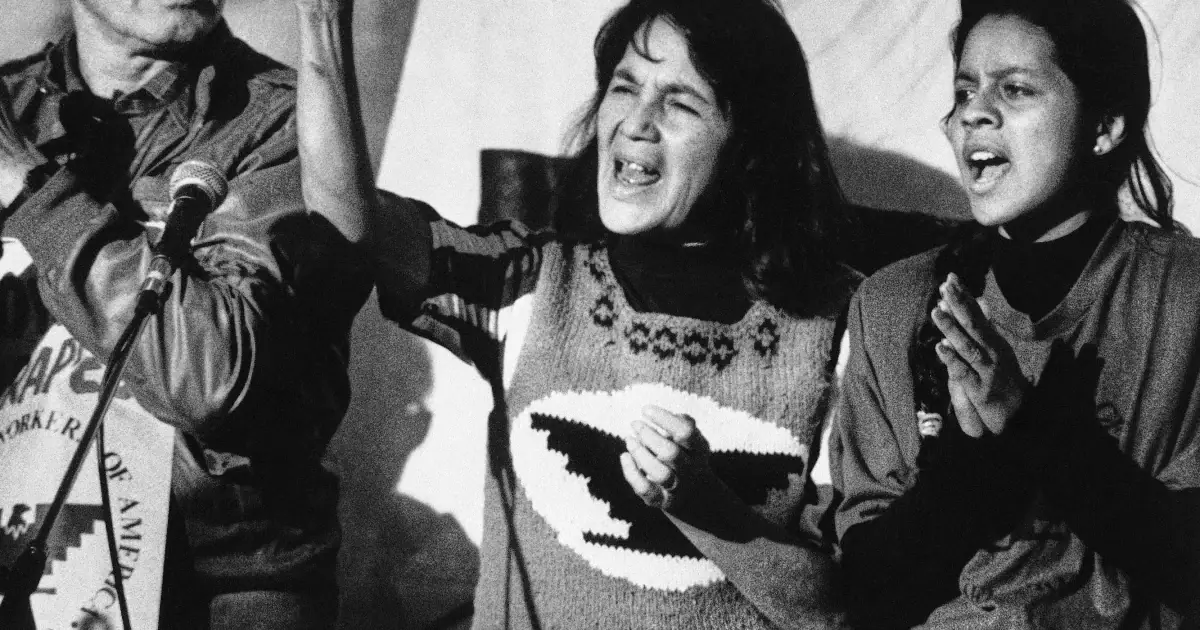
Dolores Huerta, a pioneering labor leader, feminist, and civil rights icon, has died at the age of 96. Her family confirmed her passing, which occurred at her home. Huerta co-founded the United Farm Workers union, improving working conditions for farmworkers and coining the rallying cry "Sí, se puede!" or "Yes, it can be done." Her tireless advocacy earned her numerous accolades, including the Presidential Medal of Freedom.
Huerta's commitment to social justice was evident throughout her life. Born in 1930 in Dawson, New Mexico, she grew up in a melting pot of working families in California. Her father, a miner and union activist, instilled in her the importance of activism. Huerta's early work as an elementary school teacher in the San Joaquin Valley exposed her to the harsh realities of poverty and poor living conditions. This experience motivated her to organize farmworkers and advocate for their rights.
Huerta's partnership with César Chavez led to the formation of the National Farm Workers Association, which later became the United Farm Workers of America. She played a crucial role in negotiating collective bargaining agreements and contracts with big growers, securing better working conditions and benefits for farmworkers. Huerta's activism was not without challenges; she was jailed 22 times for union demonstrations and seriously injured during a protest in 1988.
Huerta's advocacy extended beyond farmworkers' rights. She campaigned for women's rights, encouraged Latinas to run for office, and supported Democratic presidential candidates, including Bill Clinton, Barack Obama, and Joe Biden. Her work earned her numerous honors, including induction into the National Women's Hall of Fame and nine honorary doctorates from US universities. Huerta's legacy continues to inspire, with schools, streets, and murals bearing her name.
Despite her many accomplishments, Huerta faced criticism from some liberal activists. In 2016, she endorsed Hillary Clinton over Bernie Sanders, prompting actor Rosario Dawson to accuse her of becoming "an instrument of the establishment." However, the two eventually reconciled. Huerta's personal life was also marked by challenges, including the revelation that she was sexually abused by César Chavez in the 1960s, leading to the birth of two children.
Huerta's family life was complex, with 13 children from multiple relationships. Her long-term partner, Richard Chavez, was César's brother, and together they had four children. Huerta's decision to keep her abuse a secret for 60 years was motivated by a desire to protect her life's work and the progress made for workers. In a 2026 interview, Huerta reflected on her experience, stating that it was her "personal pain" and "cross to bear."
Huerta's impact on social justice and labor rights is undeniable. Her courage and determination inspired a generation of activists, and her legacy continues to inspire today. As a testament to her enduring influence, Huerta's image appears in murals, and her name is commemorated in streets and schools across the United States. Her contributions to the labor movement and social justice have left a lasting impact on American history.
Key points
- Dolores Huerta co-founded the United Farm Workers union and coined the rallying cry "Sí, se puede!"
- Huerta earned numerous accolades, including the Presidential Medal of Freedom and induction into the National Women's Hall of Fame.
- Huerta's personal life was marked by challenges, including the revelation of sexual abuse by César Chavez and a complex family life with 13 children.