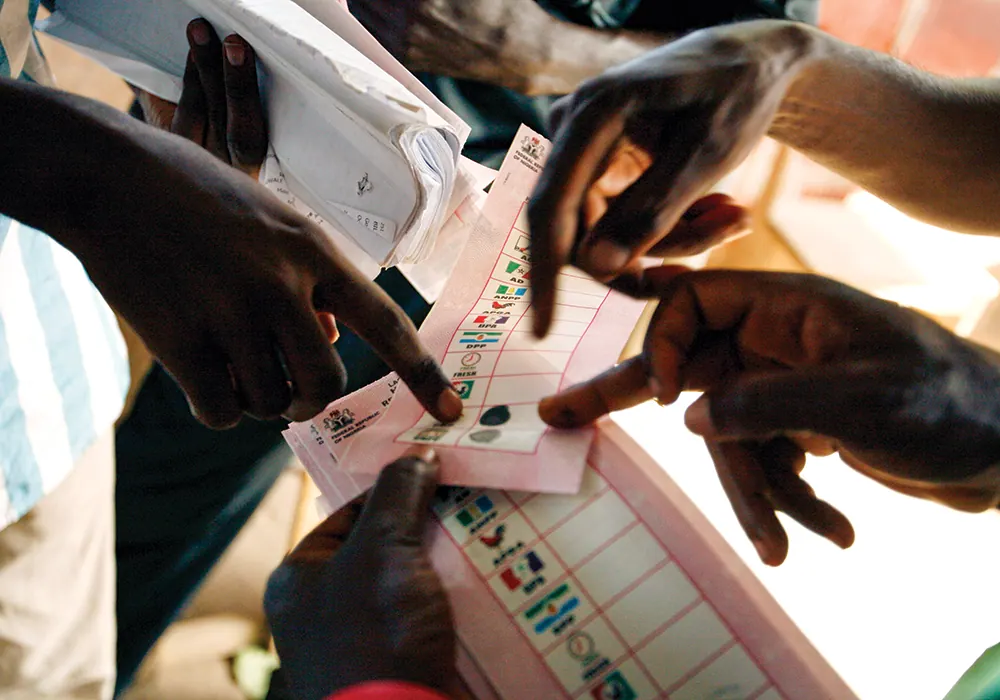
The Independent National Electoral Commission (INEC) has vowed to crack down on vote-buying and financial inducement ahead of the 2027 general elections. INEC Chairman, Prof. Joash Amupitan, stated that the commission would work with anti-graft agencies, including the Economic and Financial Crimes Commission (EFCC), the Independent Corrupt Practices and Other Related Offences Commission (ICPC), and the Nigerian Financial Intelligence Unit (NFIU), to monitor election expenditure and strengthen surveillance around polling units.
Amupitan made these remarks at a strategic workshop organised by the Nigerian Guild of Editors (NGE) in collaboration with INEC, where he sought editors' partnership in protecting the electoral process against malpractice, misinformation, and political mischief. He emphasized that elections must be decided by the conviction of the voter, not the depth of a candidate's pocket. The chairman also warned against violence, intimidation, and campaign hate speech, stressing that political competition must not descend into conduct capable of undermining credible elections.
The INEC chairman reaffirmed the commission's neutrality, stating that it has no preferred candidate, no preferred political party, and no agenda other than guaranteeing a free, fair, transparent, and credible election. Amupitan emphasized the importance of cooperation among election managers, editors, and civil society organisations in safeguarding the polls and sustaining democratic governance. He described democratic governance as a continuous journey that requires constant care, vigilance, and institutional courage.
NGE President, Eze Anaba, called for transparency, timely access to electoral information, and sustained engagement with the media, saying credible elections depended on citizens' confidence that their votes would count and electoral institutions would act fairly and professionally. Anaba stated that editors influenced the information reaching citizens, its presentation, and the context in which it was understood, making accuracy, fairness, balance, and the public interest essential obligations.
Amupitan proposed arrangements under which newsrooms would have direct access to INEC to verify incidents, logistics updates, and security reports before publication. He also disclosed that the commission would work with security agencies to protect accredited journalists and facilitate their access to polling units and collation centres. A regular feedback mechanism with the Guild would address emerging concerns throughout preparations for the elections.
On operational preparations, Amupitan said INEC was drawing lessons from recent elections and working to improve logistics, personnel deployment, and technological performance. He disclosed that early procurement and distribution of non-sensitive materials had commenced, while operational vehicles had been acquired to improve the movement of personnel and election materials. The national voter register had exceeded 103 million following the Continuous Voter Registration exercise and biometric cleanup.
The INEC chairman announced that nationwide collection of Permanent Voter Cards (PVCs) would begin on Friday, October 9, while the register would be displayed for claims and objections from October 9 to 15. He also disclosed the acquisition of 57,000 new Bimodal Voter Accreditation System (BVAS) devices, saying the commission was strengthening established technologies ahead of the polls.
Key points
- INEC Chairman warns of arrest and prosecution for vote-buying and financial inducement.
- The commission seeks editors' partnership in protecting the electoral process against malpractice, misinformation, and political mischief.
- INEC has acquired 57,000 new BVAS devices and strengthened established technologies ahead of the polls.