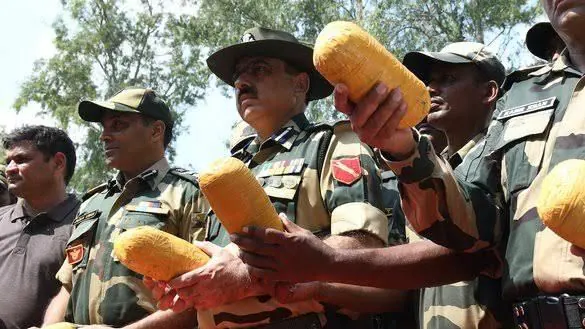
India's fight against illicit drug trafficking has received a significant boost following a major seizure of 526kg of high-grade heroin and methamphetamine in the Arabian Sea. The operation, which took place towards the end of September, involved India's central intelligence agencies, the Indian Coast Guard (ICG), and the Gujarat Anti-Terrorism Squad (ATS). The breakthrough resulted from a 16-day intelligence-driven operation that tracked and intercepted an Iranian dhow, the Azad.
The dhow's Pakistani crew of five was arrested and taken to Mumbai for interrogation. Following a court appearance, the accused were remanded in police custody. The seized drugs are reportedly worth millions of dollars. Union Home Minister Amit Shah commented on the success of the coordinated operation, highlighting the Modi government's determination to protect India's youth from the scourge of drugs.
The operation demonstrates India's escalating battle against narcotics trafficking, revealing both challenges and triumphs in a country caught between two of the world's most notorious drug regions. India is particularly vulnerable due to its location between the Golden Crescent, comprising Afghanistan, Pakistan, and Iran, and the Golden Triangle, encompassing parts of Myanmar, Laos, and Thailand.
The Golden Crescent is a major source of heroin and other opiates, while the Golden Triangle is a significant centre for methamphetamine and opium production. India's proximity to Afghanistan, historically the world's largest producer of illicit opium, has made the country an important transit route. Law enforcement agencies face an uphill battle in securing the country's extensive borders.
The illicit drug trade reportedly generates between $300 billion and $500 billion annually, accounting for a significant share of transnational organised crime. In India, estimates indicate that more than 22 million people use opioids, while more than 31 million use cannabis. The nexus between illicit drug money, cross-border terrorism, and local insurgencies is a growing concern.
To combat the issue, New Delhi has adopted a tougher approach, intensifying raids, seizures, and intelligence-led operations. The strategy is comprehensive and multi-pronged, combining high-tech border surveillance, international cooperation, law enforcement, and public-health interventions. India is deploying technologies, including artificial intelligence, drones, and satellite imagery, to identify trafficking routes and track emerging patterns in the drug trade.
The latest bust follows several major seizures in recent years, including the country's largest maritime drug seizure in November 2024, confiscating 6,016.87kg of methamphetamine worth about $3.81 billion. India's battle against illicit drugs is far from over, but through a combination of intelligence-led enforcement, technological innovation, and international cooperation, New Delhi is seeking to disrupt trafficking networks at every stage of the supply chain.
Key points
- The operation demonstrates India's determination to protect its youth from the scourge of drugs.
- India is vulnerable to drug trafficking due to its location between the Golden Crescent and Golden Triangle.
- The illicit drug trade generates between $300 billion and $500 billion annually.