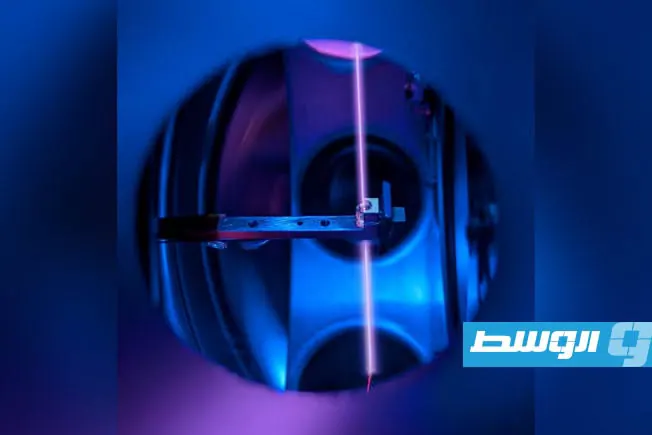
Researchers from China's Tsinghua University and Austria's Vienna University of Technology have made a significant breakthrough in physics, developing the world's first nuclear clocks. This innovative technology measures time with unprecedented accuracy, using atomic nuclei instead of electrons. The new clocks have the potential to revolutionize our understanding of the fundamental laws of physics and improve navigation and communication technologies. The research was published in the journal Nature.
Unlike traditional atomic clocks, which rely on electron transitions, nuclear clocks measure energy changes within the nucleus itself. The team used the rare isotope thorium-229 to achieve this feat. By applying a specific wavelength of ultraviolet laser light to calcium fluoride crystals, the researchers were able to modify the energy state of the thorium nuclei. This allowed them to synchronize the laser with the nucleus and achieve a record-breaking accuracy of one part in a quadrillion.
The development of nuclear clocks marks a significant advancement in timekeeping technology. The new clocks have the potential to improve the accuracy of navigation systems, such as those used in satellite technology, and enable more precise communication networks. Additionally, nuclear clocks could provide a new tool for testing fundamental physical constants and exploring the mysteries of the universe.
The research team used a specific isotope, thorium-229, which is the only known nucleus that can be modified using ultraviolet laser light. The isotope was chosen for its unique properties, which allow it to be excited using a specific wavelength of light. By harnessing this property, the researchers were able to develop a clock that measures time with unprecedented accuracy.
The implications of this breakthrough extend beyond timekeeping technology. Nuclear clocks could provide a new tool for scientists to test fundamental physical theories and explore the mysteries of the universe. The clocks could also be used to study the properties of atomic nuclei and gain a deeper understanding of the strong nuclear force.
The development of nuclear clocks is a significant achievement that demonstrates the power of interdisciplinary research. The collaboration between researchers from China and Austria has resulted in a breakthrough that could have far-reaching implications for our understanding of the universe. The research has the potential to inspire new areas of study and drive innovation in fields such as physics, engineering, and technology.
The nuclear clocks developed by the research team have the potential to be used in a variety of applications, from navigation and communication to scientific research and exploration. As the technology continues to evolve, it is likely to have a significant impact on our understanding of the universe and our daily lives. The breakthrough is a testament to the power of human ingenuity and the importance of continued investment in scientific research.
Key points
- Nuclear clocks measure time with unprecedented accuracy using atomic nuclei.
- The technology has the potential to revolutionize navigation and communication systems.
- Nuclear clocks could provide a new tool for testing fundamental physical constants and exploring the mysteries of the universe.