French historian Laurent Douzou has come forward to challenge the commonly-held notion of a unified French Resistance myth during World War II. In his work, Douzou argues that the concept of a "myth" has been used without proper reflection on its implications. According to Douzou, a myth is a narrative that provides a society with stability and cohesion, facilitating common life and acceptance of rules. However, when applied to the French Resistance, the term "myth" is used trivially to describe what is not conform to reality or is exaggerated for ideological purposes.
Douzou distinguishes between a myth and a legend, noting that the French Resistance created a legendary narrative through its actions, which were often magnified as they occurred. The Resistance used legend and propaganda to appear more powerful than it actually was. For instance, the legend of a courageous leader or group was constructed by magnifying their feats. This legendary narrative was an essential tool for the Resistance, as it helped to recruit new members and inspire action.
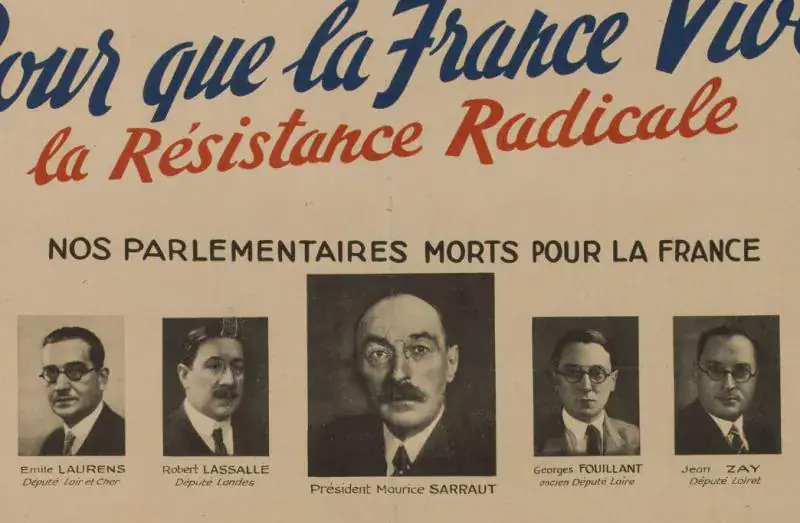
According to Douzou, the myth of the French Resistance, as described by historian Henry Rousso, served to minimize the crimes of Vichy and exalt the Resistance as a unifying phenomenon. However, Douzou disputes this notion, arguing that there never existed a coherent myth of the Resistance that was universally accepted. Instead, there are multiple memories of the Resistance, often conflicting, which vary depending on one's political affiliation. For example, communists celebrate figures like Guy Môquet, while Gaullists honor Honoré D'Estienne d'Orves or Jean Moulin.
The fragmented nature of the French Resistance's memory has made it challenging to commemorate the event. Official commemorations, such as the panthéonization of Jean Moulin, have been rare attempts to present a unified Resistance. However, the clandestine nature of the Resistance and the lack of archives have made it difficult to leave a lasting legacy. Furthermore, the Resistance's narrative has been complicated by the fact that it was often portrayed as a minority phenomenon, which created a dilemma for those who participated in it.
Those who were part of the Resistance faced a difficult situation when trying to share their experiences. If they emphasized the minority nature of the Resistance, they risked implying that the rest of the population was not involved. On the other hand, if they claimed to have been supported by the population, they risked downplaying the clandestine nature of their actions. As a result, the memory of the Resistance was not widely shared for a long time.
However, in the second half of the 1970s, those who were part of the Resistance began to speak out against negationism and share their experiences. This led to a gradual release of previously suppressed narratives and a convergence of different memories. The willingness of individuals to share their stories has helped to create a more nuanced understanding of the Resistance and its complexities.
The evolution of the Resistance's memory has been marked by a growing recognition of its complexities and nuances. As historian Laurent Douzou's work demonstrates, the myth of the French Resistance is more accurately understood as a collection of multiple, sometimes conflicting, memories. By acknowledging and exploring these different perspectives, a more accurate understanding of this significant event in French history can be gained.
Key points
- Historian Laurent Douzou disputes the notion of a unified French Resistance myth, suggesting instead that multiple, sometimes conflicting, memories exist.