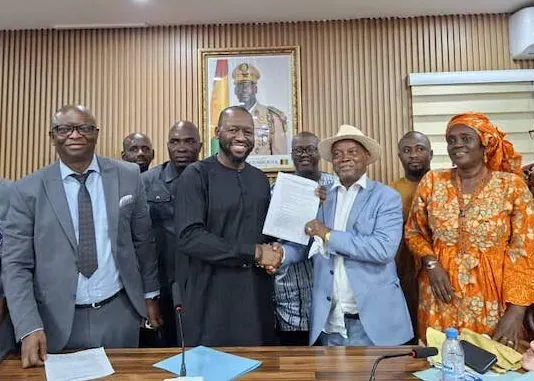
As the new school year approaches, Guinea's education sector is bracing for a recruitment process that has sparked concerns among teacher unions. The unions, led by Michel Pépé Balamou and Aboubacar Soumah, have been pressing for better working conditions and employment security for teachers. A protocol agreement signed on January 3, 2026, outlines the terms for recruiting new teachers and regularizing the status of existing contract teachers.
The protocol agreement provides for the establishment of a commission comprising representatives from the Ministry of Public Service, the Ministry of Pre-University Education, and the Intersyndicale de l'Éducation. This commission will review the lists of contract teachers who have undergone biometric registration and practical classroom evaluations. The agreement prioritizes teachers who have obtained a satisfactory grade in these evaluations for future recruitment.
According to the agreement, contract teachers from Conakry will be invited to prepare for upcoming competitive exams or practical classroom assessments, to which they will be given priority access. However, the agreement does not provide for automatic exemption from competitive exams or integration into the public service. The "priority" accorded to certain contract teachers refers to preferential treatment in the recruitment process, without dispensing them from selection tests.
The Intersyndicale de l'Éducation has expressed concerns over the recruitment process, arguing that the priority given to certain contract teachers undermines the competitive exam process. However, the government has reaffirmed its commitment to honoring its engagements under the protocol agreement, including the revaluation of teacher allowances and the establishment of medical coverage for public servants.
The government has reportedly honored several commitments under the dialogue with social partners, including the revaluation of preparation, chalk, and documentation allowances, as well as the revision of transport and housing allowances. A source close to the matter has confirmed that the competitive exam will take place as planned, with the government maintaining its position on recruitment and pursuing reforms in the education sector.
The unions' threat of a strike has raised concerns about the smooth start of the new school year. However, the government has reiterated its responsibility to ensure the proper functioning of the education system, in accordance with the principles governing access to public service. The situation remains tense, with the unions and the government locked in a standoff over teacher employment and working conditions.
The recruitment process is expected to proceed according to plan, with the commission established under the protocol agreement set to play a key role in the regularization of contract teachers. The government has urged calm and appealed to the unions to work collaboratively to ensure a successful school year. The outcome of the recruitment process will have significant implications for the education sector in Guinea.
Key points
- The Guinea government has reaffirmed its commitment to honoring its engagements under the protocol agreement.
- The recruitment process will prioritize contract teachers who have obtained a satisfactory grade in practical classroom evaluations.
- The Intersyndicale de l'Éducation has expressed concerns over the recruitment process, arguing that it undermines the competitive exam process.