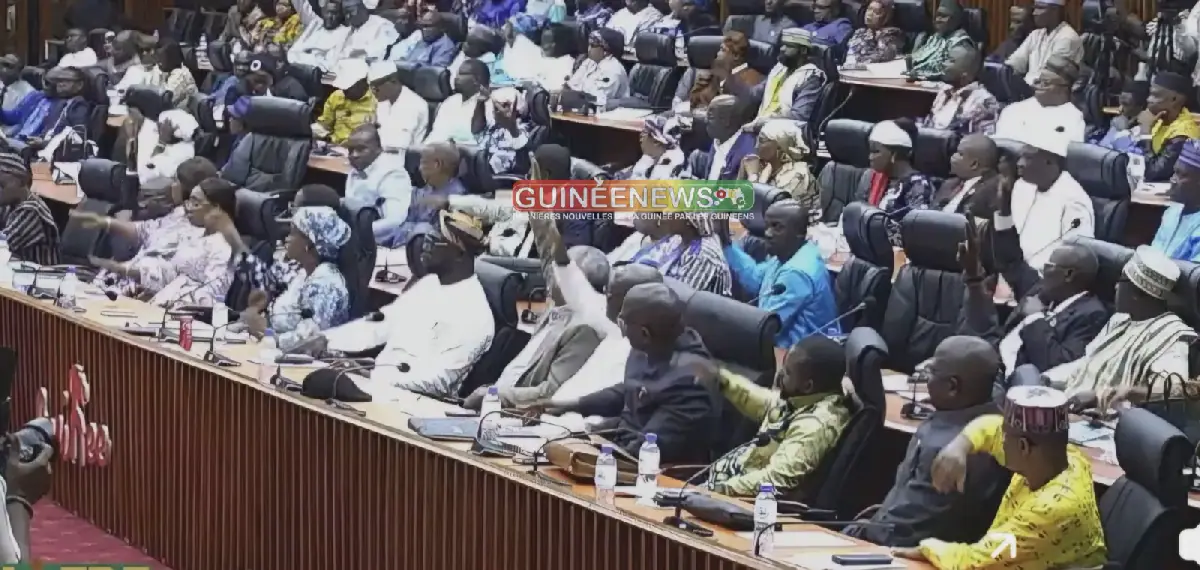
The Guinean National Assembly voted unanimously on October 31, 2026, to approve the revised 2026 Finance Bill, which reflects adjustments to the country's macroeconomic indicators in response to global geopolitical shifts. The revised budget aims to address the challenges posed by these shifts while ensuring transparency and fiscal discipline. The bill was passed after weeks of intense debate in committee, overseen by financial regulators.
The revised budget, which translates to 60,064.47 billion GNF, represents a significant increase in state revenue. According to the report read by the Assembly's rapporteur general, N'Gouamou Fabara Koné, the macroeconomic aggregates have been revised. The growth objective for the Gross Domestic Product (GDP) has been adjusted downward from 9.5% to 8.6%. The nominal GDP has also been revised to 392,503 billion GNF, down from 401,670 billion GNF.
Inflation has been revised upward to 5.2%, compared to the initial projection of 3.5%. The exchange rate is set at 8,710 GNF per US dollar. Despite a projected tax pressure of 14.23% of GDP, up from 12.13% in the initial budget, the budget deficit has improved slightly to -2.01% of GDP. The revised budget aims to strike a balance between revenue growth and expenditure management.
The state revenue forecast has been revised upward by 7.53% to 60,064.47 billion GNF, up from 55,858.10 billion GNF in the initial budget. This increase is driven by growth in taxes on goods and services, as well as foreign trade. The general budget accounts for 57,664.90 billion GNF of the total revenue, representing a 7.92% increase. The increase is largely driven by higher taxes on goods and services and foreign trade.
The revised budget also includes special allocation budgets worth 2,399.57 billion GNF, representing 3.99% of total revenue. To mitigate the social impact of the budget revisions, the government has introduced measures to cushion the effects of revenue shortfalls. These measures include absorbing petroleum revenue losses to maintain fuel prices at 12,000 GNF per liter and allocating 913 billion GNF to stabilize prices.
The revised budget also provides for increased borrowing through bond issues and government securities. The budget includes an additional 1,089.84 billion GNF in bond issues and 1,000 billion GNF in government securities. These measures aim to ensure that the government meets its revenue targets while maintaining macroeconomic stability.
The approval of the revised budget reflects the government's efforts to navigate the challenges posed by global geopolitical shifts. The budget revisions demonstrate a commitment to fiscal discipline and transparency, while addressing the social and economic impacts of these shifts. The implementation of the revised budget will be closely monitored by the government and other stakeholders.
Key points
- The revised 2026 budget for Guinea has been approved by parliament, reflecting adjustments to macroeconomic indicators amid global geopolitical shifts.
- The budget has been revised upward to 60,064.47 billion GNF, representing a 7.53% increase in state revenue.
- The revised budget includes measures to mitigate the social impact of revenue shortfalls, such as absorbing petroleum revenue losses and allocating funds to stabilize prices.