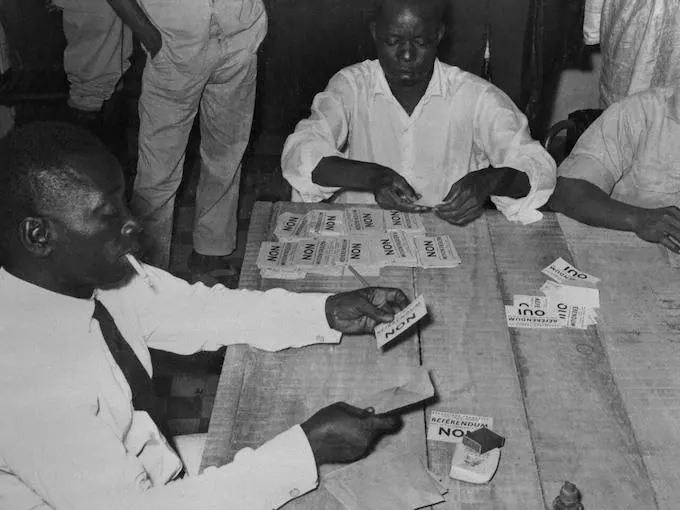
On September 28, 1958, Guinean voters made a historic decision, rejecting the French constitution and paving the way for the country's independence. The referendum, proposed by French General Charles de Gaulle, offered colonies in French West Africa and French Equatorial Africa the option to join a "French Community" or break ties with France. Guinea was the only territory in French-speaking Africa to vote "no," with an estimated 94% of voters rejecting the proposal.
In the late 1950s, Guinea was undergoing significant sociopolitical changes. The Democratic Party of Guinea (PDG), led by Ahmed Sékou Touré, had become the dominant political force, advocating for social emancipation and an end to colonial discrimination. The party's popularity among peasants, workers, and civil servants helped galvanize support for independence. Opposition parties, such as the Bloc Africain de Guinée and the Démocratie Socialiste de Guinée, took more moderate stances on decolonization.
Several key figures played important roles in the referendum. Ahmed Sékou Touré, leader of the PDG, became the face of the opposition to the French Community. General Charles de Gaulle, President of the French Council, sought to maintain close ties between France and its colonies. Other notable figures, including Barry Diawadou and Barry III, initially supported the French Community but eventually joined the "no" campaign. French officials, such as Minister of Overseas France Bernard Cornut-Gentille and Governor of French Guinea Jean Risterucci, oversaw the referendum.
A pivotal moment in the lead-up to the referendum was de Gaulle's visit to Conakry on August 25, 1958. During a speech at the Territorial Assembly, Touré famously declared, "We prefer freedom in poverty to wealth in servitude." De Gaulle responded, "Independence is at the disposal of Guinea. She can take it on September 28 by answering 'no' to the proposal... I guarantee that the Metropolis will not put any obstacles in its way." This exchange set the stage for the "no" vote.
On September 28, 1958, Guineans went to the polls, and the results confirmed a resounding "no" to the French constitution, with 1,136,000 votes against and approximately 57,000 "yes" votes. The French government immediately took note of Guinea's desire for independence, ceasing financial and administrative support. French officials, technicians, and equipment were withdrawn or destroyed.
Four days after the referendum, on October 2, 1958, the Territorial Assembly of Conakry proclaimed itself the National Constituent Assembly and declared Guinea's independence. Ahmed Sékou Touré was elected as the country's first president. Guinea's "no" vote made it a pioneer in the independence movement in French-speaking sub-Saharan Africa, inspiring a wave of decolonization that swept across the region in 1960.
Historians and scholars continue to recognize the significance of Guinea's 1958 referendum. According to Professor Ibrahima Caba Bah, "1960 was the consequence of 1958... The independence of Guinea was a fact of God... When Guinea took its independence, the other countries saw that it did not fall." Current Prime Minister Amadou Oury Bah noted that Guinea's 1958 referendum projected a desire for transformation, freedom, and dignity, making it a reference point for the early days of independence.
Key points
- Guinea's 1958 referendum was a pivotal moment in African history, marking the country's transition to independence and inspiring a wave of decolonization across the region.