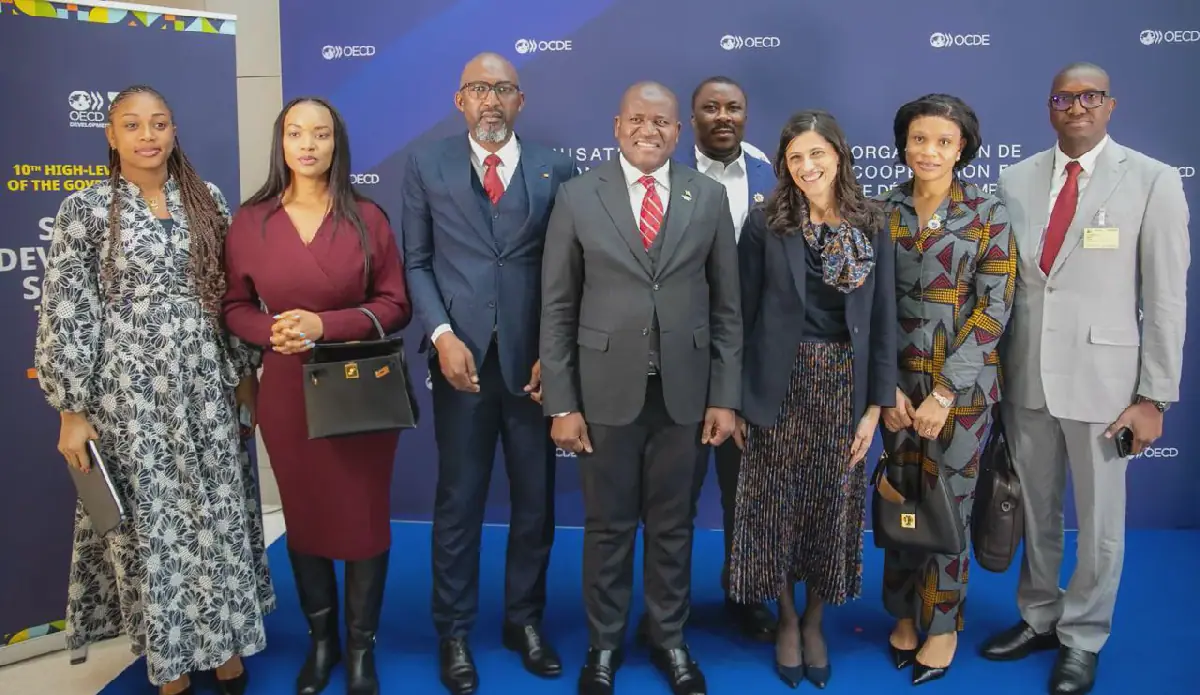
The Republic of Guinea has officially joined the Steering Committee of the OECD Development Centre in Paris as its 56th member. This development was announced on November 26, 2026, at the 10th high-level meeting of the Steering Committee, held at the Château de la Muette in Paris. Guinea's entry into the committee is seen as a significant step in its multilateral engagement. The country's Minister of Planning, International Cooperation, and Development, Ismaël Nabé, represented Guinea at the meeting.
The admission of Guinea to the OECD Development Centre Steering Committee follows that of Mauritania earlier in the year, expanding West African representation within the organization. Minister Nabé expressed a "deep sense of honor" and "real awareness of our responsibility" on behalf of President Mamadi Doumbouya. He was accompanied by a technical team, including the Director General of the National Institute of Statistics, Dr. Makan Doumbouya, and the Deputy Director General of the Bureau for Cooperation with the European Union, Kadiatou Diallo.
Guinea's integration into the OECD Development Centre Steering Committee was achieved within a tight timeline. On June 25, Minister Nabé and the Governor of the Central Bank presented Guinea's candidacy and ongoing reforms to the Steering Committee. A formal agreement was reached on September 16, which was followed by an improvement in the country's risk classification by the OECD from category 7 to category 6 in mid-October.
Minister Nabé emphasized that Guinea's economic future should not rely solely on the exploitation of its mineral resources. He stated that the country's natural resources, demographic potential, and ambitions must be converted into productive capacities, infrastructure, decent jobs, and shared prosperity. The Simandou 2040 program was presented as a vision to build a diversified, industrialized, competitive, and resilient economy.
The Simandou 2040 program aims to go beyond the valorization of Guinea's mineral resources. Minister Nabé stressed that the program requires suitable financing, solid institutions, coherent public policies, and effective partnerships to produce tangible results. By joining the OECD Development Centre Steering Committee, Guinea aims to contribute to the reflection, dialogue, and collective action to build future development trajectories.
Minister Nabé warned that Guinea does not intend to adopt a purely receptive posture within the committee. He called for consideration of the specificity of African realities and the need for more balanced partnerships. According to Minister Nabé, development can only be sustainable if it is shared and inclusive, creating opportunities for all.
With his appointment as head of the Council of Governors of the West African Development and Investment Bank (BIDC) in April, Minister Nabé has taken on additional responsibilities. He has been in office since March 2024 and is expected to play a key role in shaping Guinea's economic development and regional cooperation.
Key points
- Guinea becomes 56th member of OECD Development Centre Steering Committee
- Minister Ismaël Nabé emphasizes need for diversified economy beyond mineral resources
- Simandou 2040 program aims to build diversified, industrialized, and resilient economy