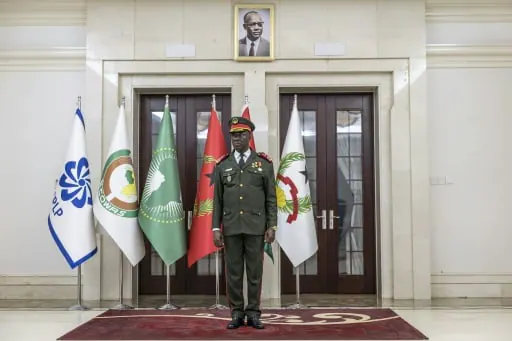
Guinea-Bissau's junta leader, General Horta N'Tam, has called on members of the presidential guard loyal to exiled former president Umaro Sissoco Embalo to voluntarily disarm. This appeal was made on Wednesday, as the junta seeks to consolidate power and move towards restoring civilian rule. The presidential guard, seen as loyal to Embalo, has been a point of contention since the junta seized power in November.
The junta, established under N'Tam, a close associate of Embalo, has set December 6 as the date for presidential and legislative elections. These elections aim to restore civilian rule in the perennially unstable and poor west African nation. However, the former president, Embalo, told AFP in late September that he planned to return to stand in the polls, which could potentially complicate the electoral process.
The junta had previously announced that "security conditions" were not met for Embalo's return, fueling reports of discontent within the presidential guard. Several members of the guard were subsequently disarmed and placed under supervision at military headquarters. This move was seen as a precautionary measure to prevent potential unrest.
General Horta N'Tam emphasized that a commission had been created to recover weapons and military equipment issued to members of the presidential guard. He warned that anyone still keeping weapons should return them immediately or face consequences if they refused. The junta leader also stated that the unit had been poorly organised under the previous administration but insisted that none of its members had been expelled from the armed forces.
Many observers suspected Embalo of orchestrating the November 26 coup to halt an election process he appeared to be losing. The coup occurred one day before provisional results were to be announced, sparking concerns about the country's stability. Since then, the junta has taken several steps suggesting it is distancing itself from the former president.
A diplomat based in Bissau said Horta N'Tam appeared determined to remain a central political figure while creating distance from Embalo. The diplomat also questioned whether elections would take place in December, citing the possibility of a postponement. This uncertainty has added to the country's already complex and volatile political landscape.
Guinea-Bissau, a Portuguese-speaking country wedged between Senegal and Guinea, has experienced five coups and numerous attempted putsches since independence from Portugal in 1974. The nation's crippling poverty and political chaos have also made it a fertile ground for corruption and drug smuggling, further complicating its path towards stability and democracy.
Key points
- The junta leader, General Horta N'Tam, has urged members of the presidential guard to voluntarily disarm.
- The junta has set December 6 as the date for presidential and legislative elections to restore civilian rule.
- The country's stability remains uncertain, with concerns about potential postponement of the elections.