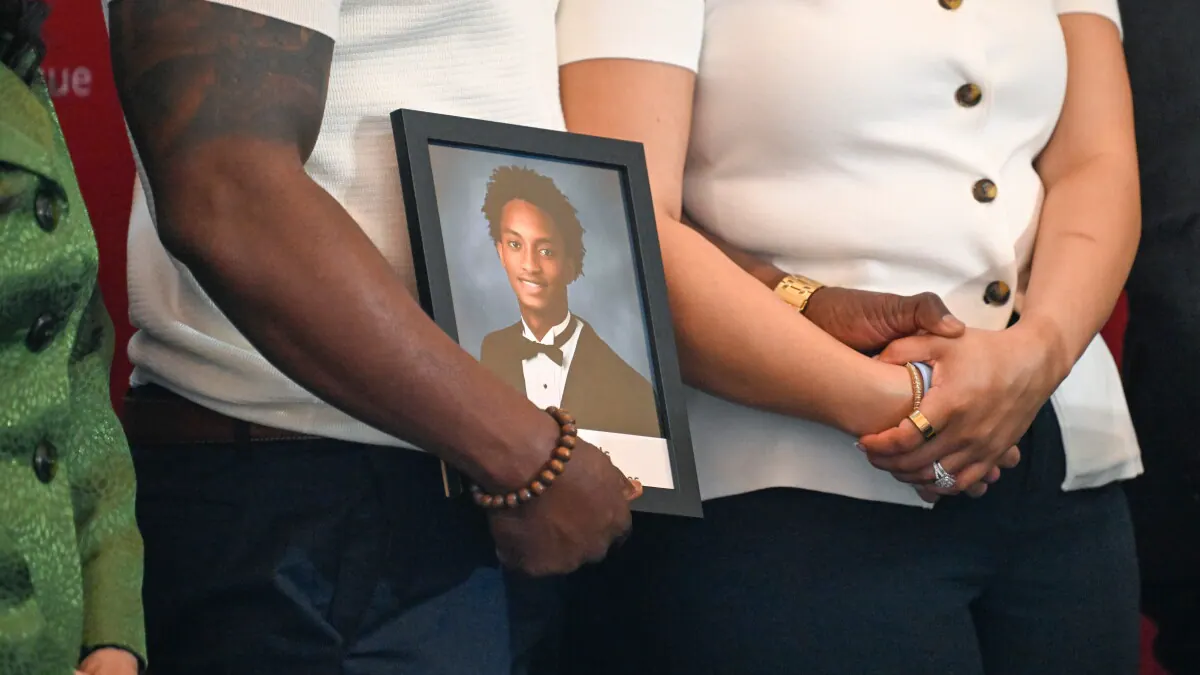
A Mississippi grand jury has decided there's not enough evidence to bring charges in the case of Nolan Wells, a Black teenager who was found dead off the Mississippi coast in early July. The grand jury, which met from September 14 to September 18, ultimately found that Wells' cause of death was undetermined and based on the condition of his body and where it was found, his death was "consistent with drowning." The investigation involved over 100 subpoenas, 40 witnesses, and evidence ranging from GPS data to cellphone extractions.
Activists, attorneys, and Wells' family are continuing to push for answers. Civil rights attorney Ben Crump, representing Wells' family, highlighted a detail mentioned in the medical examiner's report: the bruising on the back of Wells' head, which the report said was not a fatal injury. Crump urged the district attorney to keep the investigation open, emphasizing the need for clarity on what caused the blunt force trauma to Wells' head.
The NAACP is pushing the district attorney's office to release its own report to the public. Kristen Clarke, NAACP general counsel, wrote that Wells' family deserves a full, fair, and independent investigation that is exhaustive and leaves no stone unturned. The NAACP's call for transparency comes as the grand jury report emphasized that despite public assertions that Wells was the only Black person on Horn Island that day, those assertions were false.
Wells was the only Black teen among the group of friends that traveled to Horn Island on July 4, and his family has repeatedly questioned if the investigation would have gone differently with a white teenager. However, District Attorney Angel Myers McIlrath said those concerns are baseless, stating that the family, the Crump team, and anyone close to Wells knew that his disappearance and death were not the result of racial hate or violence.
The grand jury report noted that Wells chose to stay on Horn Island that day, characterizing it as "not unusual or suspicious for individuals to return from the island on boats they did not travel on." The report also emphasized that there had been a thorough search of Horn Island on July 5 before Wells' body was discovered the following day. According to the report, had his body been on the island at that time, it would have been discovered during the extensive search.
Dr. Roger Mitchell, the forensic pathologist who performed an independent autopsy, concluded along with the state medical examiner that the cause and manner of Wells' death is "undetermined" and that "drowning is a diagnosis of exclusion." Crump has previously said that Mitchell did not have access to parts of Wells' body during the independent autopsy, but the grand jury report disputes that assertion.
Crump released his team's independent autopsy on Monday night, which recommends keeping the investigation open due to uncertainties surrounding Wells' death and the condition he was in when he entered the water. The report also raised questions about whether Wells entered the water voluntarily or was forced, and whether he was conscious or impaired. Key issues also include disputes over Wells' cell phone data and allegations of lack of cooperation from the Crump team.
Key points
- The grand jury's decision not to indict anyone in Nolan Wells' death has raised concerns about the investigation's thoroughness and potential racial bias.
- The NAACP and Wells' family are pushing for transparency and further investigation into the circumstances surrounding Wells' death.
- Disputes over Wells' cell phone data and allegations of lack of cooperation from the Crump team have added to the controversy surrounding the case.