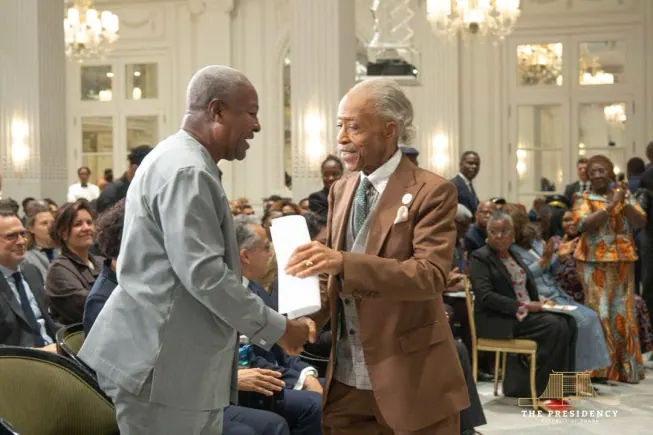
President John Dramani Mahama of Ghana has called on the United Nations and holding nations to move beyond piecemeal acts of goodwill and build a permanent, institutionalized global system for the restitution of Africa's cultural heritage. He made this appeal at the Next Steps High-Level Side Event on Reparatory Justice on the sidelines of the 81st United Nations General Assembly in New York. The event was co-hosted by Ghana, Germany, and France as a follow-up to the historic adoption of UN General Assembly Resolution and the High-Level Consultative Conference on Reparatory Justice held in Accra in June this year.
President Mahama stressed that the debate on restitution was not about static objects in museum cases, but about people, dignity, and an unfinished journey toward justice. He cited Ghana's experience, recalling the British destruction of Kumasi in 1874 and the looting of the palace of the Asantehene. A century and a half later, in 2024, a portion of that heritage returned, including the sacred Mpomponsuo sword. This, he said, reminded us that these are not mere relics of a bygone era, but belong to living traditions, active institutions, and communities that are still here.
The President described the removal of the physical remains of ancestors as the most heartbreaking form of dispossession. He mentioned the case of King Badu Bonsu II of Ahanta, who was executed by hanging and decapitated by Dutch colonial authorities in 1838. His head was sent to the Netherlands for phrenology studies and was preserved in a jar of formaldehyde for 170 years. Rediscovered by a Dutch journalist in 2002, the head was finally returned to Ghana in 2009. President Mahama emphasized that human remains are not collectibles, but our ancestors, and restoring them is not a matter of legal ownership, but a fundamental test of our shared human dignity.
President Mahama rejected the argument that restitution must wait until African nations build modern facilities. He stated that capacity constraints must never be used as a justification for continued possession. Instead, capacity must serve as a bridge to return, not a barrier to justice. Africa is already building the infrastructure of the future through the African Union's Agenda 2063 flagship project, the Great African Museum, and the AU-EU Museum Partnership, as well as Ghana's own construction of state-of-the-art national and traditional institutions to preserve, research, and exhibit returning treasures.
The President emphasized that cultural heritage is not a luxury to be addressed after economic development, but an engine of development. Properly preserved and showcased, it fuels education, identity, international tourism, and the booming creative economy. He called on multilateral development banks, international financial institutions, global foundations, and private sector partners to invest deliberately in Africa's cultural infrastructure, including regional archives, conservation laboratories, digitization initiatives, and professional training for a new generation of African curators and historians.
President Mahama described the adoption of the UN Resolution as an indispensable moment of global truth, adding that truth is not the destination, but the starting line. He acknowledged progress made by some holding nations, including the Netherlands, Germany, and France. However, he stressed that moral justice cannot rely on piecemeal generosity or isolated acts of goodwill. The President called for a partnership with the present to repair the future, stating that Ghana does not come to this hall to assign guilt for the past, but to forge a partnership to repair the future.
The Minister of Foreign Affairs, Samuel Okudzeto Ablakwa, disclosed that Ghana has received formal notice from the United States of America that it is willing to work with Ghana towards a fair and just reparatory justice process, despite voting against the UN Resolution. President Mahama concluded that the story of Africa's cultural heritage cannot end with its removal, but must continue with its return. He urged the international community to work together to build a brighter future for all.
Key points
- President Mahama calls for a permanent, institutionalized global system for the restitution of Africa's cultural heritage.
- The President emphasizes that human remains are not collectibles, but our ancestors, and restoring them is a fundamental test of our shared human dignity.
- President Mahama stresses that cultural heritage is not a luxury to be addressed after economic development, but an engine of development.