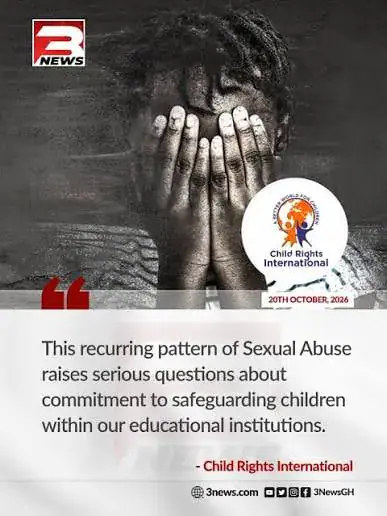
A recent case in Obuasi Senior High Technical School has brought to light the disturbing trend of child abuse in Ghana's educational institutions. In February 2026, the school's Girl Child Coordinator and safeguarding officer petitioned school management over allegations of sexual assault by the headmaster. Despite multiple complaints from students, the matter was only reported to the police in August 2026, after a 20-year-old Form Two student lodged a complaint with DOVVSU.
According to Eduwatch, the Obuasi West Municipal Director of Education confirmed that five girls reported alleged sexual assault by the headmaster to his office in March 2026, with three submitting written complaints. The Minister of Education has since announced that 19 students identified in connection with the allegations will receive support. However, human rights activist Tutu Baffour Asare Brownsy Williams argues that the silence and inaction of authorities and parents have enabled the abuse to persist.
The issue of child abuse in Ghana extends far beyond the school gates, with many cases beginning in homes where parents have neglected or abandoned their children. Ghana's police data shows that neglected children are the most vulnerable to defilement, with 31,480 children abandoned or neglected by parents and guardians over a six-year period. In 2011 alone, 5,797 children were abandoned or neglected, and 1,168 defilement cases followed.
The problem is further complicated by the stigma and shame associated with child abuse, particularly for boys. UNICEF's 2024 global estimates found that an estimated 240 to 310 million boys and men experienced rape or sexual assault during childhood. In Ghana, a study by Quarshie (2021) found that 10.4% of teenage boys in Senior High Schools in the Greater Accra Region had experienced sexual violence. However, DOVVSU data from 2014 recorded only eight male victims of defilement.
Tutu Baffour Asare Brownsy Williams argues that the failure to address child abuse is a result of several factors, including victim blaming and disbelief, settling cases out of court, delay and bureaucracy, and corruption and complicity. He cites a Ghanaian academic review that noted some in society blame the victims of defilement for their predicament. Additionally, DOVVSU has cautioned against settling sexual offences out of court, warning that it amounts to committing a criminal offence.
The consequences of inaction can be devastating, as seen in the case of Jerry Sandusky, a celebrated assistant football coach at Penn State who was convicted of 45 counts of sexual abuse of 10 boys over 15 years. The world has also seen how institutions can fail to protect children, with Sandusky finding many of his victims through The Second Mile, a charity he founded for underprivileged youth.
The Minister of Education's announcement that 19 students will receive support is a step in the right direction. However, Tutu Baffour Asare Brownsy Williams emphasizes that more needs to be done to address the root causes of child abuse and neglect in Ghana.
Key points
- Ghana's authorities and parents are urged to take action to prevent child abuse and neglect.
- The country's police data shows a high rate of child abandonment and neglect, which can lead to defilement.
- Boys are also victims of child abuse, but are often stigmatized and ignored.