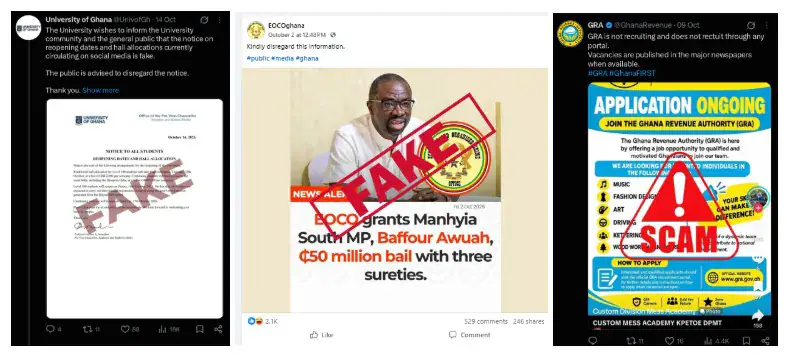
In October 2026, various institutions in Ghana took steps to address and clarify misinformation circulating online. As part of GhanaFact's monthly monitoring of social media misinformation, a report was compiled highlighting disclaimers issued by both public and private institutions. These efforts aimed to safeguard the public from financial scams and false information. A total of nine government institutions and two private media outlets, TV3 and GHOne TV, were involved in debunking misinformation or issuing public alerts.
The Economic and Organised Crime Office (EOCO) was one of the institutions that issued a disclaimer on October 2, 2026, regarding a fake flyer circulating on social media. The flyer, attributed to GHOne TV, claimed that EOCO had granted a GH¢50 million bail to the Manhyia South MP, Nana Agyei Baffour Awuah. However, EOCO labelled the flyer as fake, stating that it had not made such a decision. Several media outlets had published news materials suggesting that EOCO was demanding a GH₵50 million bail bond for the MP, but on October 3, 2026, the MP was granted bail of GH¢10 million by the Accra High Court.
Another incident involved GHOne TV, which issued a disclaimer on October 1, 2026, regarding a fake flyer circulating on Instagram and Facebook. The flyer claimed that the President of the Ghana Football Association (GFA), Kurt Okraku, made a statement about the NPP party and the national teams. GHOne TV stated that the news flyer was fake and did not originate from their outlet or EIB Network. The flyer had been shared on Facebook by different accounts, garnering 120 reactions, 317 comments, and 12 shares.
The Ghana Revenue Authority (GRA) also responded to allegations of extortion involving its officers and a passenger, Gifty Osei Bonsu, at the Accra International Airport. On October 9, 2026, the GRA issued a disclaimer addressing the incident, which had sparked widespread debate and reactions on social media. The GRA explained that a technical challenge with the Integrated Customs Management System (ICUMS) had delayed payment and issuance of a receipt, and that the customer had made a total payment of GH¢800 while GRA officers added GH¢7.68 from their personal funds to complete the payment.
In addition to these incidents, other government institutions, including the University of Ghana (UG) and the Driver and Vehicle Licensing Authority (DVLA), took steps to address misinformation online. These efforts demonstrate the growing awareness among institutions in Ghana of the need to combat digital misinformation and protect the public from financial scams.
The increasing prevalence of misinformation online has led to a growing concern among stakeholders in Ghana. As a result, institutions are taking proactive steps to clarify and debunk false information. The GhanaFact report highlights the importance of monitoring social media misinformation and the role that institutions can play in mitigating its impact.
The efforts of these institutions in Ghana to combat digital misinformation are crucial in maintaining public trust and preventing financial scams. By issuing disclaimers and public alerts, they are able to quickly respond to and address false information, thereby protecting the public and promoting a safer online environment.
Key points
- Institutions in Ghana issued disclaimers and public alerts to combat misinformation online in October 2026.
- Nine government institutions and two private media outlets were involved in debunking misinformation or issuing public alerts.
- The efforts of these institutions aim to safeguard the public from financial scams and false information.