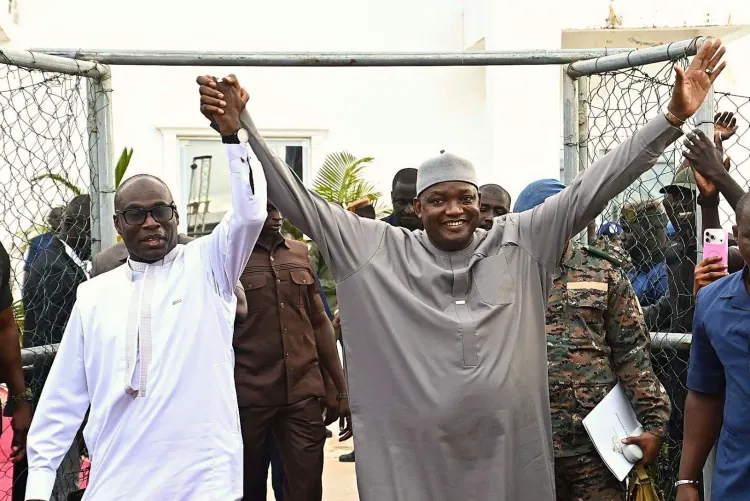
Gambian President Adama Barrow has made a significant move ahead of the 2026 presidential election by forming a grand alliance with two prominent opposition figures, Essa Faal and Mamma Kandeh. This development has sparked interest and debate among Gambians and international observers alike. Faal, a former prosecutor of the Truth, Reconciliation and Reparations Commission (TRRC), and Kandeh, a longtime politician, have joined Barrow's coalition, which could potentially give him an edge in the upcoming election. The move is seen as a strategic effort to consolidate support and strengthen Barrow's position.
The Gambian president's decision to form an alliance with Faal and Kandeh has been met with a mix of reactions from the public and opposition parties. Some have expressed concerns that the move could be a ploy to further entrench Barrow's power, while others see it as a positive step towards promoting national unity and stability. The opposition parties, including Gambia First led by Darboe, Coalition 2026 led by Bensouda, and the PDOIS, have been critical of Barrow's leadership but have not yet responded to the new alliance. The election is seen as a crucial test of Gambian democracy.
The Gambian democracy has made significant progress since the ousting of former President Yahya Jammeh in 2017. However, the country's stability and economic growth, largely driven by tourism, remain fragile. The tourism industry, which is the country's main economic driver, requires a stable and secure environment to thrive. Barrow's administration has emphasized the importance of maintaining peace and stability to attract foreign investment and promote economic growth. A successful election would help to reinforce this message and demonstrate the country's commitment to democratic principles.
The formation of the grand alliance has also raised questions about the future of Gambian politics and the role of opposition parties. The opposition has been divided, with several parties and leaders vying for support. The PDOIS, Gambia First, and Coalition 2026 have all expressed concerns about Barrow's leadership but have not yet presented a united front. The new alliance has created an opportunity for Barrow to engage with opposition leaders and potentially build a broader base of support. However, critics argue that the move could also further entrench Barrow's power and undermine the opposition.
The international community has been closely watching the developments in Gambia, with many observers emphasizing the importance of a peaceful and democratic transition of power. The European Union, in particular, has been a key partner for Gambia, providing significant economic and technical assistance. The EU has emphasized the need for Gambia to maintain its democratic gains and ensure a level playing field for all parties ahead of the election. A successful election would help to reinforce Gambia's relations with the EU and other international partners.
As the election approaches, Gambians are increasingly focused on the future of their country and the kind of leadership they want. The debate has centered on issues such as economic development, corruption, and human rights. Barrow's administration has made efforts to address these issues, but critics argue that more needs to be done. The opposition has also presented alternative policies and programs, but it remains to be seen whether they will be able to present a united front and challenge Barrow's coalition.
In the end, the success of Gambian democracy will depend on the ability of its leaders to prioritize national interests and work towards a common goal. The election will be a critical test of the country's democratic institutions and its ability to manage power transitions peacefully. As Alpha Abdoulaye Diallo noted, the responsibility for protecting Gambian democracy rests not only with the government but also with opposition leaders and civil society. The country's future prosperity and stability depend on its ability to maintain peace, promote tolerance, and protect the space for democratic debate.
Key points
- President Adama Barrow's grand alliance with Essa Faal and Mamma Kandeh has significant implications for the country's democratic future.
- The Gambian opposition has been divided, with several parties and leaders vying for support ahead of the 2026 election.
- The international community has been closely watching developments in Gambia, emphasizing the importance of a peaceful and democratic transition of power.