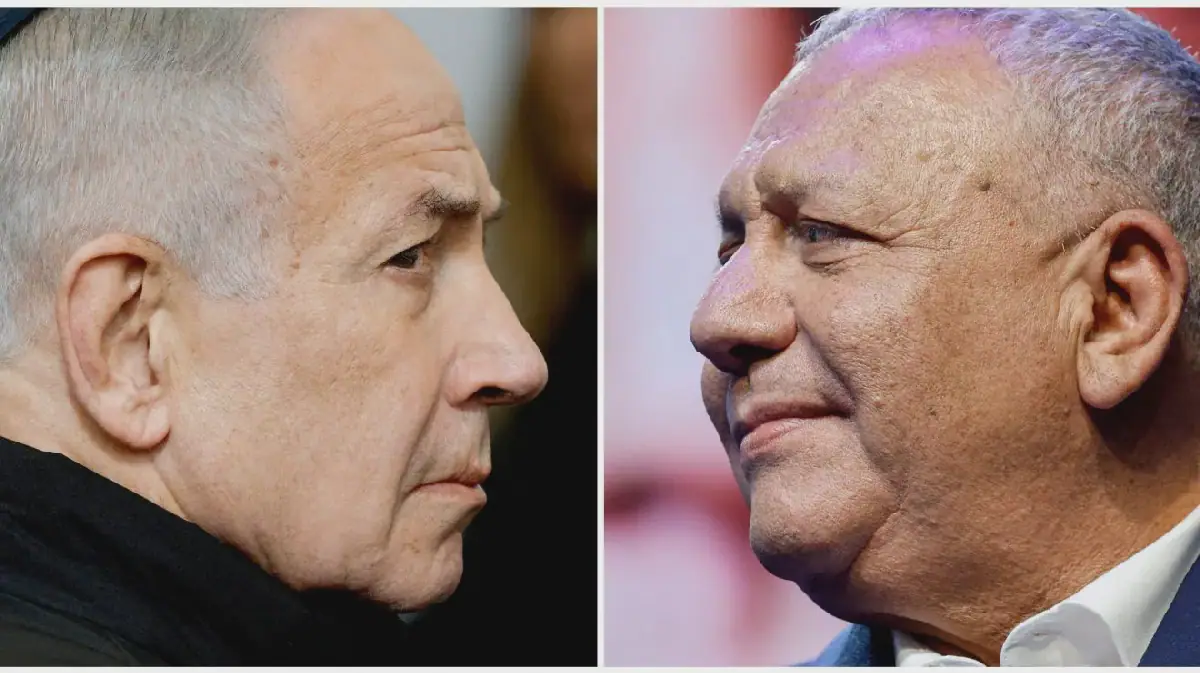
Former Israeli military chief Gadi Eisenkot has been given the task of forming a new government in Israel. Israeli President Isaac Herzog officially handed Eisenkot the task on Sunday, following a deadlocked election that failed to dislodge Prime Minister Benjamin Netanyahu. The October 27 election left both Eisenkot and Netanyahu short of the majority needed to govern. Herzog cited a threat of attack from Iran, the need to progress towards peace in Gaza, and negotiations with Lebanon and other neighbours as key challenges facing Israel.
Eisenkot's path to power is uncertain, with several potential pathways available. He could try to form a minority government with Arab party support for key issues, form a coalition with ultra-Orthodox parties that he and his allies have shunned in the past, or forge a unity government with Netanyahu. All three options face formidable obstacles. Eisenkot said he will call on all parties to join who meet his main principles, including recognition of Israel as a Jewish and democratic state.
Eisenkot's principles for forming a government also include a duty of national service for all to strengthen the military and expand its ranks, and recognition of Hamas as a terrorist organization and a commitment to destroying its military and governing capacity. He said he is convinced that it is possible and right to form a new government quickly, one that will win a large majority in the Knesset, Israel's parliament.
Eisenkot now has 28 days plus a possible 14-day extension to form a government. If he fails, Netanyahu will likely get his shot at forming a government. Should he also be unable, new elections could be called. Herzog said Eisenkot received the "clear and unequivocal support" of a majority of lawmakers on who has the better chance of forming the next government that will win the confidence of the Knesset.
The recent election saw Netanyahu's Likud win the most seats of any single party with 27 in the 120-seat Knesset, but Netanyahu's wider religious-nationalist coalition garnered only 53 in total, short of a 61-seat majority in the 120-seat parliament. Eisenkot's Yashar party emerged as the second-largest party with 21 seats, while his coalition, spanning four centre-left to right-wing Jewish-led parties, won just 48 seats.
Two parties representing Israel's Arab minority won an unprecedented 19 seats in the election. Netanyahu called for a unity government of all Zionist parties to preserve a Jewish state, but gave no indication whether he would work with Arab parties. Eisenkot's potential coalition partners include ultra-Orthodox parties that he has previously shunned.
Avigdor Lieberman, a potential coalition partner, has indicated that he could work with ultra-Orthodox parties. Eisenkot said Israeli democracy was at a vulnerable moment, with immense challenges facing the country. He emphasized the need for new leadership that people can trust, and said that forming a national emergency government would require creative and unconventional political steps.
Key points
- Eisenkot has 42 days to form a government, with a possible 14-day extension.
- Netanyahu's Likud won 27 seats in the 120-seat Knesset.
- Eisenkot's Yashar party won 21 seats in the election.