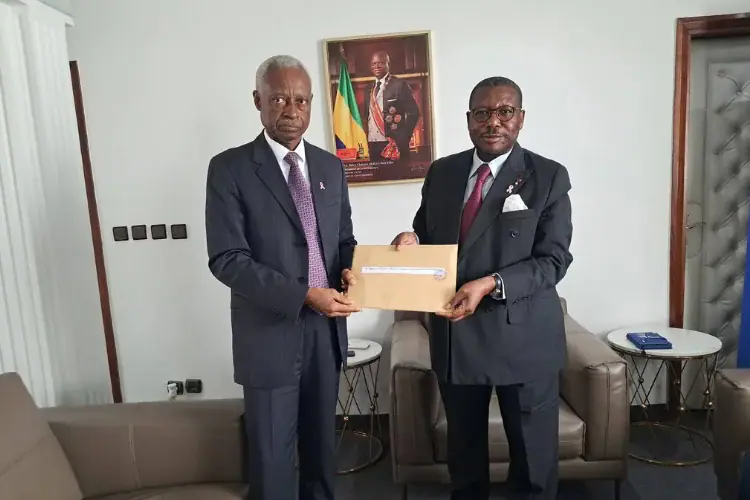
The Association of Gabonese Mayors (AMG) has taken steps to convey their recommendations to major institutions of the Republic, following their general assembly. The mayors' report was submitted to President Ali Bongo Ondimba, Interior Minister Edgard Moukoumbi, and Senate President Huguette Nyana Ekoume-Awori Onanga. This move brings the issue of genuine decentralization to the forefront. The report, presented by Eugène M'ba, president of the AMG and mayor of Libreville, outlines concerns and proposals to enhance local government functionality.
The mayors' recommendations focus on improving budget execution, particularly for interior communes, optimizing financial resources, providing suitable technical means, and strengthening local government capabilities. They aim to advance the transfer of competencies from the central state to local authorities. However, this transfer of responsibilities without corresponding resources remains a significant challenge. Mayors, as direct interlocutors with populations, face limitations in responding to public service and local development expectations due to restricted resources and prerogatives.
Interior Minister Edgard Moukoumbi reaffirmed the head of state's commitment to accelerating decentralization, deemed irreversible. The practical implementation of this ambition remains uncertain. Local governments now expect operational responses. The decentralization process should not merely be a transfer of responsibilities without accompanying necessary resources. This concern is central to the mayors' demands.
The Association of Gabonese Mayors' démarche aims to emphasize the need for tangible decentralization. Following their general assembly in Franceville, the mayors are determined to push for more than just promises. Their proposals intend to improve local governance and address populations' expectations. The mayors' capacity to respond to these expectations is closely tied to the resources and prerogatives at their disposal.
Local governments face significant challenges in executing their mandates due to limited resources. The mayors' report highlights these constraints and formulates proposals to overcome them. By transmitting their recommendations to key institutions, the mayors demonstrate their commitment to achieving tangible decentralization. The involvement of high-ranking officials, such as the President and Senate President, underscores the importance of this issue.
The decentralization process in Gabon has been ongoing, with varying degrees of success. The current efforts by the mayors aim to reinvigorate this process, ensuring that local governments have the necessary means to effectively serve their populations. This involves not only a transfer of responsibilities but also the provision of adequate resources. The outcome of these efforts will likely have a significant impact on local governance in Gabon.
The mayors' initiative has sparked renewed attention to decentralization in Gabon. As the country navigates this complex process, the roles of various stakeholders, including local governments, the central state, and institutions, will be crucial. The effectiveness of decentralization will depend on the ability of these stakeholders to collaborate and address the challenges faced by local governments.
Key points
- Gabonese mayors are pressing for tangible decentralization and the transfer of necessary resources to local governments.
- The mayors' recommendations focus on improving budget execution, optimizing financial resources, and strengthening local government capabilities.
- The decentralization process in Gabon is deemed irreversible, but its practical implementation remains uncertain.