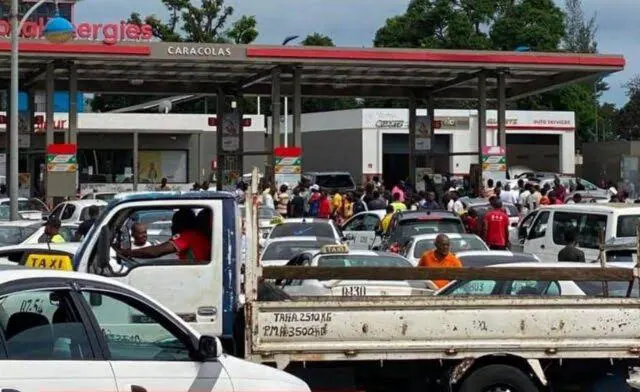
The city of Malabo in Equatorial Guinea is experiencing difficulties accessing gasoline at various fuel stations as of Monday, October 5. This situation affects not only drivers who need fuel to continue working but also urban transportation, with direct consequences for users. One of the first repercussions is the increase in the price of some taxi rides.
Drivers consulted agree that the long waits and time spent finding fuel reduce their effective working hours and increase associated costs. They claim that if a significant part of the day is spent queuing or traveling to different fuel stations to get gasoline, they need to recover that lost time somehow. For users, however, the result translates into a more expensive service and, at certain times, more difficult to find.
The problem also affects the relationship between drivers and vehicle owners. In addition to the difficulty in obtaining fuel, there is another less visible issue: the economic relationship between drivers and vehicle owners. Some taxi drivers argue that vehicle owners continue to demand agreed-upon daily amounts, regardless of the extraordinary difficulties the sector faces.
From this perspective, the driver faces double pressure: they must assume the consequences of a day when it is more complicated to work and, at the same time, fulfill the economic conditions agreed upon with the vehicle owner. The situation opens a debate on whether agreements between owners and drivers should include mechanisms or clauses for exceptional situations, such as periods of difficulty accessing fuel.
It is not just about determining who should bear the cost of a situation like the current one. It also raises the need to review how risks are distributed when normal working conditions change significantly. While owners and drivers seek to maintain their respective incomes, part of that impact ends up reaching the citizen.
The increase in the price of certain routes particularly affects those who depend daily on taxis to go to work, move to educational centers, run errands, or return home. Added to this are the delays caused by the lower availability of vehicles and the time drivers must dedicate to obtaining fuel.
The result is a chain of effects that begins at the fuel stations and ends in the daily life of the population: less time available to work, greater difficulty finding transportation, and a higher cost to move around. The issue raised by this situation goes beyond the scarcity of gasoline and also puts on the table how the different parts of the chain should respond to exceptional circumstances that alter the usual working conditions.
Key points
- Fuel scarcity in Malabo leads to increased taxi fares and delays.
- The situation affects not only drivers but also urban transportation and users.
- The economic relationship between drivers and vehicle owners is also impacted.