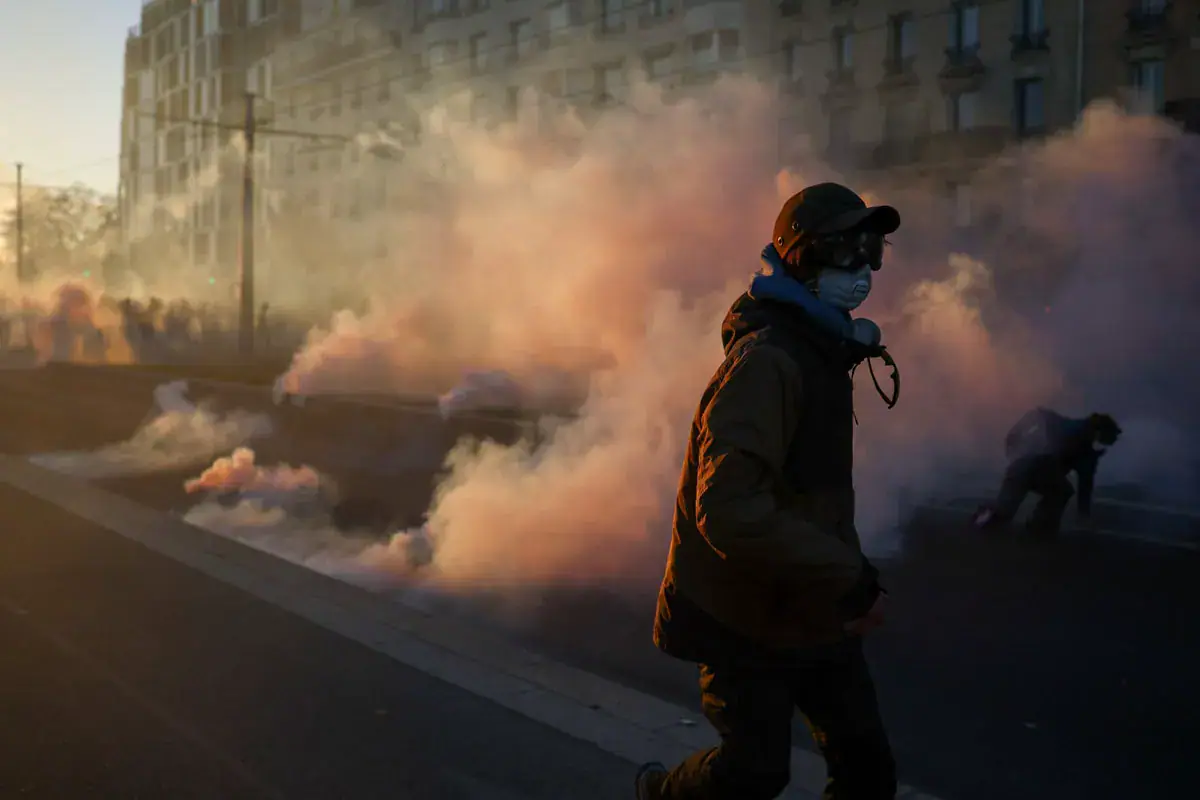
On Halloween night, police in Paris resorted to tear gas to disperse violent protesters as anti-government demonstrations swept across France. The protests, which marked the third consecutive weekend of unrest, drew over 300,000 participants nationwide, according to authorities. Despite the large turnout, significant violence was reported, raising concerns about potential unrest after dark.
The protests were not limited to France, as incidents of violence were also reported in Germany, particularly in Frankfurt, where protesters threw Molotov cocktails at police. In response to the escalating situation, around 70,000 police officers and gendarmes were stationed across France, rerouting marches away from central areas to minimize damage and maintain public safety.
French Interior Minister Laurent Nuñez had warned of a “very high risk” of coordinated disorder, stressing that Halloween festivities would not be an excuse for violence or mask-wearing. The minister's concerns were echoed by the deployment of a significant police presence, aimed at preventing a repeat of the serious unrest that had characterized the previous two weekends.
Saturday's mobilisations followed two weekends of serious unrest involving rioting, looting, and mass arrests. In Paris, thousands gathered at Porte de Bagnolet in eastern part of the city, with high school students leading the march. The protests stem from students walking out over worsening conditions in schools and concerns about a university admissions process perceived as unfair.
University student Corentin Cabreux highlighted the dire conditions of student housing as a motivation for attending the protest. Mr Cabreux expressed hopes for a peaceful demonstration to counter government narratives framing the movement as mere cover for rioting. His sentiments reflect a broader desire among protesters to challenge the government's policies without resorting to violence.
Criticism over police crowd-control methods has surged due to repeated use of tear gas and other forceful measures. The protests have evolved into a broader challenge to President Emmanuel Macron’s government, drawing support from trade unions and leftist groups against economic reforms. To prevent further unrest, President Macron has restricted access to central retail areas during protests, implementing a curfew for unaccompanied minors around the Champs-Élysées.
The discontent in France mirrors rising youth frustrations across Europe. Protests have also erupted in Albania, Italy, and Germany, where young people are demanding better living conditions and education funding while opposing military conscription. In Spain, police in Barcelona heightened emergency alerts in response to calls for new protests, following a previous weekend that ended with approximately 130 arrests.
Key points
- Over 300,000 people participated in largely peaceful demonstrations across France.
- The protests stem from students' concerns about worsening school conditions and an unfair university admissions process.
- The movement has evolved into a broader challenge to President Emmanuel Macron's government, drawing support from trade unions and leftist groups.