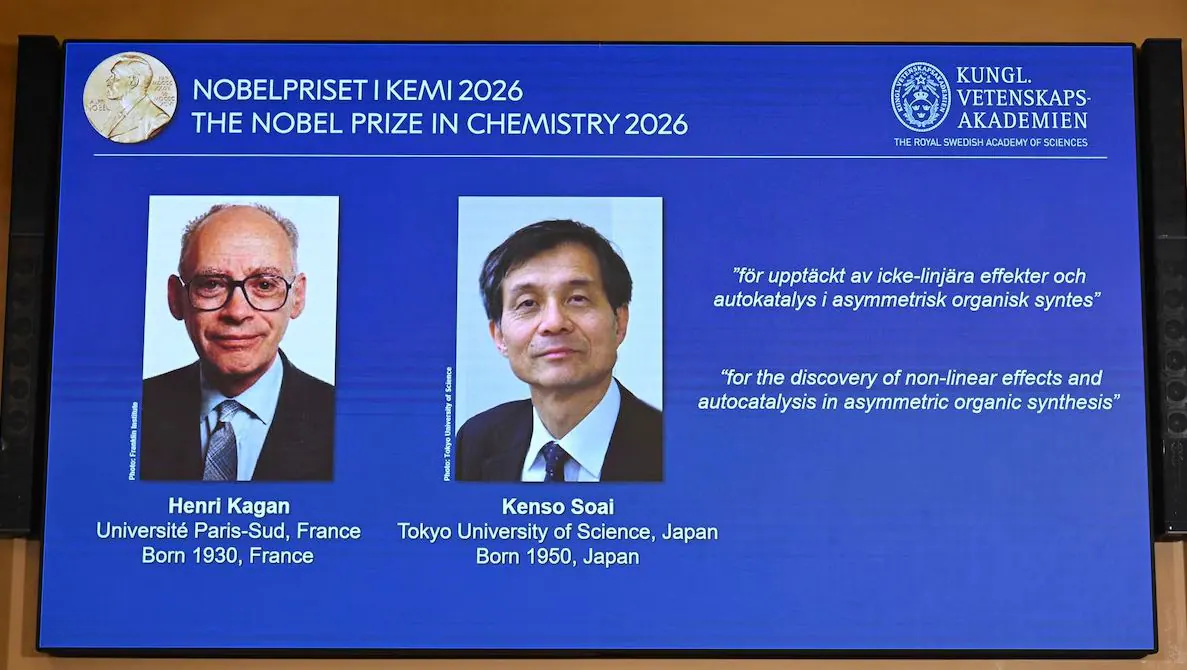
The Royal Swedish Academy of Sciences announced the winners of the 2026 Nobel Prize in Chemistry on Wednesday, October 7, 2026. Henri Kagan from France and Kenso Sawai from Japan were recognized for their pioneering work on non-linear and self-catalytic effects in asymmetric organic synthesis. This discovery has significant implications for the field of chemistry, enabling the creation of complex molecules with unprecedented precision.
The Nobel Prize in Chemistry is one of the most prestigious scientific awards in the world, with a history dating back over a century. The prize is awarded annually by the Royal Swedish Academy of Sciences, which recognizes outstanding contributions in the field of chemistry. The winners receive a cash award of 12 million Swedish kronor (approximately $1.2 million) and international recognition for their work.
Henri Kagan and Kenso Sawai's research focused on asymmetric organic synthesis, a crucial process in the development of pharmaceuticals and other complex molecules. Their discovery of non-linear and self-catalytic effects has opened up new avenues for the synthesis of chiral molecules, which are essential for the production of many medicines.
The Nobel Prize in Chemistry is not only a recognition of the winners' achievements but also a testament to the importance of fundamental scientific research. The prize highlights the significance of basic research in driving innovation and advancing our understanding of the world. The discovery made by Kagan and Sawai is a prime example of how fundamental research can lead to breakthroughs with far-reaching implications.
The awarding of the Nobel Prize in Chemistry to Henri Kagan and Kenso Sawai is a significant event in the scientific community, and it is expected to inspire future generations of researchers. The prize is a reminder of the importance of international collaboration and the exchange of ideas in driving scientific progress. Kagan and Sawai's work is a testament to the power of collaboration and the impact that scientists from different countries can have when working together.
The 2026 Nobel Prize in Chemistry is a notable achievement for both Henri Kagan and Kenso Sawai, and it is expected to have a lasting impact on the field of chemistry. The discovery made by the two scientists has the potential to lead to breakthroughs in various fields, including medicine and materials science. As the scientific community continues to evolve, the work of Kagan and Sawai will undoubtedly remain a significant milestone in the history of chemistry.
Key points
- The 2026 Nobel Prize in Chemistry was awarded to Henri Kagan and Kenso Sawai for their work on non-linear and self-catalytic effects in asymmetric organic synthesis.