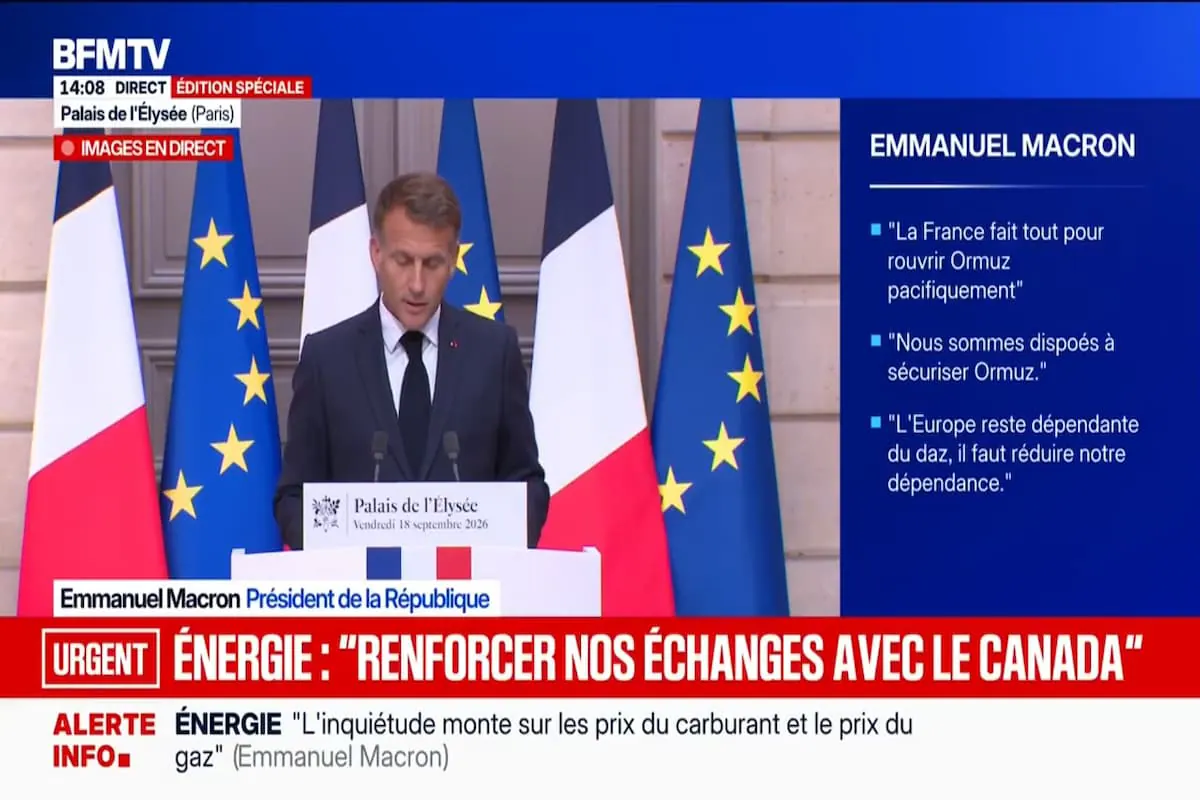
French President Emmanuel Macron has announced that France, which currently holds the G7 presidency, will convene a meeting to address the global energy crisis. The meeting will focus on coordinating a response to the rising energy prices caused by the conflict in the Middle East and supply chain disruptions. The G7 countries will discuss possible measures, including the release of strategic oil reserves and enhanced coordination on stockpiles, exports, and production capacities.
The global energy market is under pressure, with the price of Brent crude oil reaching nearly $110 per barrel before dropping to around $104 per barrel. The conflict in the Middle East has led to concerns about supply disruptions, particularly after an attack on a Saudi Arabian oil pipeline. This has contributed to higher fuel prices in Europe. The G7 aims to mitigate the impact on markets without compromising future response capabilities in case of further crisis escalation.
Macron emphasized the need for a coordinated international response to address the energy crisis. The French government is working with the International Energy Agency (IEA) to explore options for releasing strategic oil reserves. This approach has been used previously to stabilize oil markets. The goal is to ensure that G7 countries are better coordinated on stockpiles, exports, and production capacities to address the current energy price surge.
France is also focused on securing natural gas supplies for the upcoming winter. Macron stated that the country has achieved its target of filling gas storage facilities to 80% capacity. However, the French government believes that the European Union as a whole faces a more challenging situation. To address this, France plans to enhance its import capabilities for liquefied natural gas and diversify its suppliers.
Macron has been in discussions with several major oil and gas producers, including Saudi Arabia, Iraq, Qatar, the United Arab Emirates, and Nigeria. These talks aim to secure volumes of oil, gas, and refined products. France is also working to accelerate measures to reduce its dependence on hydrocarbons by optimizing refining and import capacities, strengthening logistics chains, and promoting electrification.
The French approach involves a multi-faceted strategy to address the energy crisis. This includes securing supplies, enhancing international coordination, and reducing energy dependencies. At the European level, Macron advocates for exploiting available flexibilities to reduce energy costs and promoting the use of biofuels where technically feasible. The upcoming G7 meeting will aim to finalize the available options.
The global energy market remains exposed to developments in the Middle East conflict and its impact on oil and gas flows. The G7 meeting will be crucial in determining the next steps to address the energy crisis. Key points to be discussed include the potential release of strategic reserves, enhanced coordination among G7 countries, and efforts to reduce dependence on hydrocarbons.
Key points
- France to convene G7 meeting to address rising energy prices
- G7 countries to discuss release of strategic oil reserves and coordination on stockpiles
- France seeks to secure natural gas supplies and reduce dependence on hydrocarbons