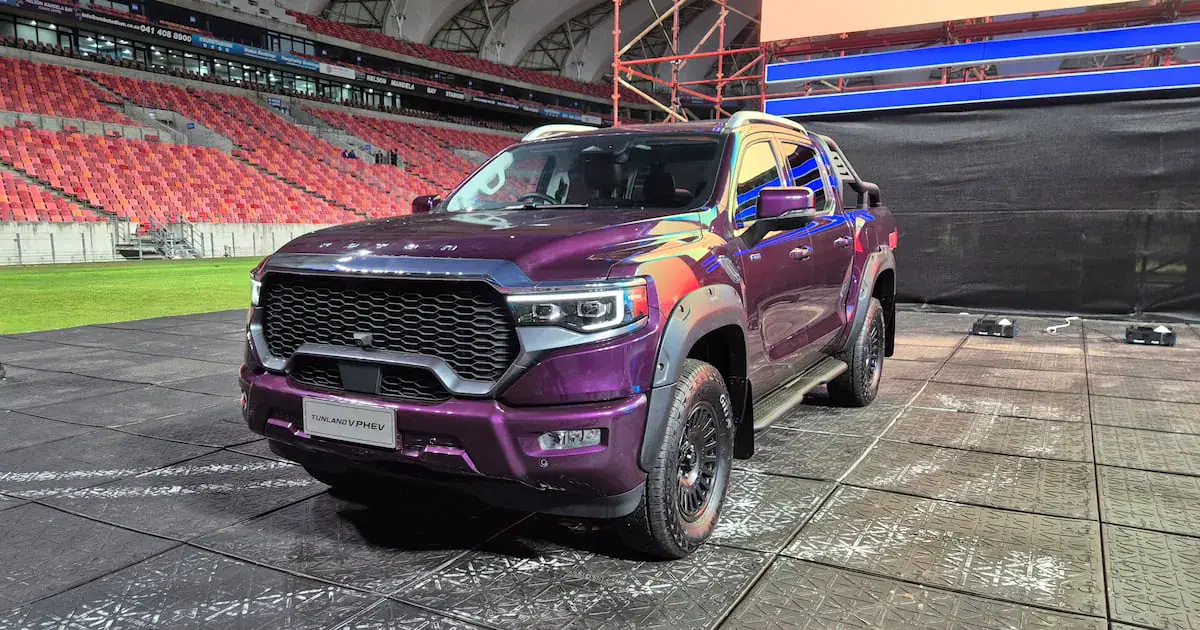
Foton SA is set to introduce the Tunland V9 plug-in hybrid bakkie to the South African market in January. The vehicle was unveiled during the BAIC Foton Africa Partners Conference in Gqeberha. The Tunland V9 range was first launched in South Africa in November 2025 in 2.0 l mild-hybrid turbodiesel variants. The new plug-in hybrid model combines rechargeable electric driving with the flexibility of a petrol engine.
The Tunland V9 PHEV features a 2.0 l turbocharged petrol engine paired with front and rear electric motors, a 32.8 kWh battery, and a four-speed hybrid transmission. This powertrain delivers a combined output of 350kW and up to 800Nm of torque. The vehicle promises a 0-100km/h acceleration time of 7.9 seconds. It offers an electric driving range of up to 110km and a combined petrol-electric driving range of 1,000km.
The Tunland V9 PHEV can be charged at home overnight, and its battery can be juiced up from 30-80% in as little as 30 minutes on a DC fast charger. Additionally, the vehicle features a 220V external power supply, allowing it to power compatible tools, camping appliances, and lighting. This makes it a versatile option for both work and leisure activities.
The Tunland V9 is one of South Africa's largest bakkies, measuring 5.6m in length and over 2m in width. Its 1.65m wide load bed is one of the industry's widest, and it has a 3.5 tonne towing capacity. The vehicle is designed to handle heavy-duty tasks while also offering luxurious features such as nappa-like leather seats and a 14.6-inch central touchscreen.
The Tunland V9 PHEV boasts advanced driver-assistance technology, including adaptive cruise control, automatic emergency braking, lane-keeping assistance, and lane-departure warning. It also features a generous 250mm ground clearance and a 4x4 system with front and rear electric differential locks, giving it real off-road capability. There are 15 drive modes for various types of terrain, including rocks, mud, and sand.
The Tunland V9 PHEV will compete against electrified double cabs such as the BYD Shark and Changan Hunter Reev. The price is yet to be confirmed but is likely to be higher than the R799,900 commanded by the current top-of-the-range Tunland V9 model. The vehicle will be imported from China, while diesel-powered variants will be built at the BAIC Foton factory in Gqeberha.
The BAIC Foton factory in Gqeberha has increased its output, with completely knocked down (CKD) manufacture of the smaller Tunland G7 bakkie range starting in 2025. The factory aims to build 10,000 units per annum by 2027, with multiple different vehicles built on the same line, including SUVs and medium and heavy trucks.
Key points
- The Tunland V9 PHEV offers a combined petrol-electric driving range of 1,000km.
- The vehicle features advanced driver-assistance technology and luxurious features.
- The Tunland V9 PHEV will compete against electrified double cabs such as the BYD Shark and Changan Hunter Reev.