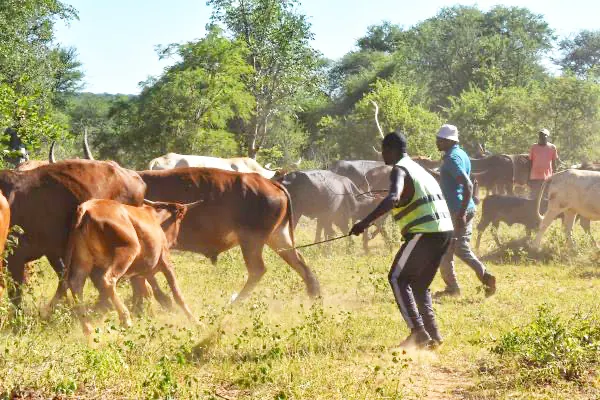
The foot-and-mouth disease outbreak in Namibia has had a significant impact on the livestock sector, but farmers are still required to pay their workers the national minimum wage. The revised minimum wage rates for agricultural workers came into effect on 1 January as part of a three-year phase-in of the national minimum wage. Agricultural workers are currently paid N$14 per hour, with a minimum wage of N$18 per hour expected next year.
The Ministry of Justice and Labour Relations has confirmed that there are currently no discussions to exempt employers in the agricultural sector from complying with the national minimum wage due to the FMD outbreak. Ministry spokesperson Maria Hedimbi stated that all employers must continue paying the national minimum wage unless the government officially announces otherwise. This means that farmers must prioritize paying their workers, even as they navigate the challenges posed by the FMD outbreak.
The impact of the FMD outbreak on farm workers and their wages is a pressing concern for regional authorities. ||Kharas governor Dawid Gertze has identified the issue as one that needs to be discussed as part of a response plan for the region. Gertze has spoken to the chief veterinary officer and is awaiting a plan for the region, but no agreement has been reached on how farmers struggling with income should deal with workers' wages.
Commercial farmers are seeking relief as they navigate the challenges posed by the FMD outbreak. Vikus Steenkamp, a commercial farmer, notes that it is still too early to assess the full impact of the outbreak on his farm, but warns that being unable to sell livestock could put farmers under financial pressure if the situation continues. Steenkamp currently uses part of his salary to support his farming operation.
Other farmers have expressed concerns about the financial strain caused by the FMD outbreak. An anonymous farmer noted that livestock sales are crucial for paying workers and covering other expenses, while Floris Fleermuys emphasized the need for clear and regular information from the government on how long restrictions are expected to remain in place. Fleermuys suggested that temporarily relaxing minimum wage requirements or providing financial support could provide some relief.
The economic assessment by Simonis Storm has revealed that the FMD outbreak could lead to significant job losses in Namibia. The report estimates that around 12 000 jobs could be lost across the country in 2026 and 2027. The Namibia Livestock Union and Namibia Agricultural Union have highlighted the importance of beef exports to the European market, which supports more than 40 000 jobs.
Labour expert Herbert Jauch has also weighed in on the issue, emphasizing the need for a comprehensive response to the FMD outbreak. While some farmers are exploring options for relief, including temporarily relaxing minimum wage requirements, others are warning that retrenchment may be a last resort. The situation remains a challenge for farmers, workers, and regional authorities alike.
Key points
- The FMD outbreak has had a significant impact on the livestock sector in Namibia.
- Farmers in Namibia are still required to pay workers the national minimum wage despite the FMD outbreak.
- The outbreak could lead to significant job losses in Namibia, with an estimated 12 000 jobs at risk.