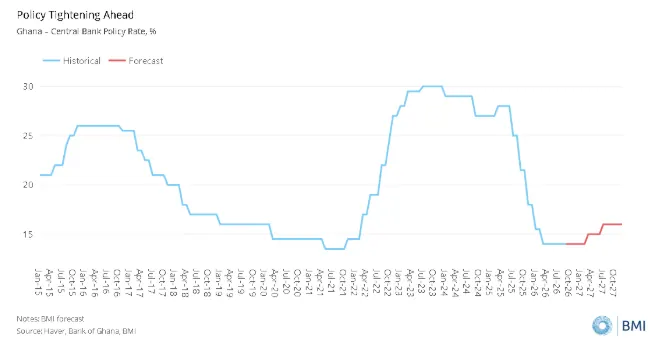
Fitch Solutions, a UK-based firm, has maintained its policy rate forecast for Ghana at 14.00% by year-end 2026. This decision comes after the Bank of Ghana (BoG) recently held its policy rate at 14% during the Monetary Policy Committee (MPC) meeting. According to Fitch Solutions, the BoG will hike the rate by 200 basis points to 16.00% in 2027.
Ghana's inflation rate has remained low this year, averaging 4.0% year-on-year, significantly below the 2010-2025 average of 15.7% and the BoG's target range of 6.0-10.0%. The firm attributes this to the lagged effects of earlier monetary tightening, favourable base effects, and a stronger cedi from a year-on-year perspective. However, inflation has risen from 3.2% in March 2026 to 5.0% in August 2026.
Fitch Solutions expects Ghana's inflation rate to continue trending higher, reaching 6.8% by year-end 2026. This forecast is primarily driven by elevated energy costs amid the ongoing US-Iran conflict and the cedi starting to weaken on a year-on-year basis. Despite this, the firm notes that inflation will remain low by Ghanaian standards and below the BoG's target midpoint through quarter 4, 2026.
The UK-based firm sees little appetite for rate cuts, making another hold in November 2026 the most likely outcome. With inflation moving higher, Fitch Solutions believes that the BoG will keep the benchmark policy rate unchanged at the final MPC meeting of 2026. This decision will be influenced by the need to balance inflationary pressures with economic growth.
Ghana's economic growth has been impacted by various factors, including the COVID-19 pandemic and global economic trends. The country's central bank has been working to maintain price stability while supporting economic growth. The BoG's policy rate decisions have a significant impact on the overall economy, influencing borrowing costs and consumer spending.
The policy rate forecast by Fitch Solutions has implications for Ghana's economic outlook. A stable policy rate is expected to support economic growth, while also keeping inflation under control. However, the firm notes that there are potential risks to the forecast, including external factors such as global economic trends and commodity prices.
In conclusion, Fitch Solutions' maintained policy rate forecast of 14% by December 2026 reflects the firm's expectations for Ghana's economic outlook. The forecast is based on various factors, including inflation trends, economic growth, and global economic conditions. The BoG's policy rate decisions will continue to play a crucial role in shaping Ghana's economic future.
Key points
- Fitch Solutions expects Ghana's inflation rate to reach 6.8% by year-end 2026.
- The firm sees little appetite for rate cuts, making another hold in November 2026 the most likely outcome.
- Ghana's inflation rate has averaged 4.0% year-on-year this year, significantly below the 2010-2025 average of 15.7%.