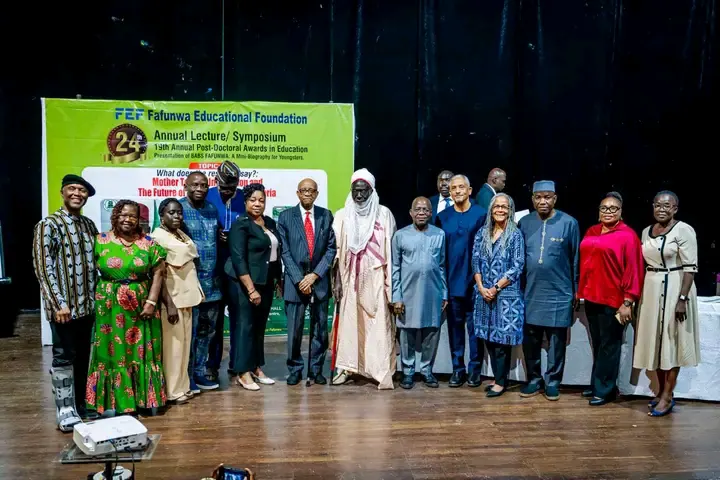
The 24th Annual Lecture/Symposium of the Fafunwa Educational Foundation and the 19th Annual Post-Doctoral Awards in Education was held on September 23, 2026, at the AGIP Recital Hall, MUSON Centre, Onikan, Lagos. The event was organised in honour of the late Professor Aliu Babatunde Fafunwa, Nigeria's first Professor of Education and former Minister of Education. The theme of the symposium, "What Does the Research Say?: Mother Tongue Instruction and the Future of Early Education in Nigeria," sparked a national conversation on the language of formal learning for Nigerian children.
Abia State Governor, Dr Alex Otti, who chaired the event, emphasised the importance of mother-tongue instruction in the evolution of education in Nigeria. He urged policymakers to address the practical challenges of teaching children in indigenous languages, rather than dismissing research that supports the approach. Otti cited examples of countries like China, India, and South Korea, where children receive foundational education in indigenous languages, yet make significant economic and technological advances.
Professor Francis Egbokhare of the Department of Linguistics and African Languages, University of Ibadan, delivered the keynote address, making a strong case for mother-tongue instruction. He argued that the language of formal education is not a neutral administrative choice, but a consequential decision that affects a child's learning experience. Egbokhare drew from his own childhood experience, illustrating how a language mismatch can lead to confusion and poor academic performance.
Egbokhare advocated for a bilingual approach, where children develop strong cognitive foundations in their mother tongue before acquiring English. He questioned the existing system, where children are taught in one language but assessed in another, describing it as fundamentally confusing. According to him, Nigeria's problem is not the conceptual validity of mother-tongue education, but its implementation, which requires solving logistical challenges.
Professor Sheri Fafunwa-Ndibe, delivering a goodwill message on behalf of her mother, Chief Mrs Doris Fafunwa, reflected on the personality and philosophy of her late father, Professor Aliu Babatunde Fafunwa. She described him as an "unrepentant optimist" who welcomed challenges and worked in the interest of the deprived majority. The event was a tribute to Fafunwa's legacy, keeping his ideas alive and encouraging Nigerians to interrogate existing institutions and assumptions.
The symposium highlighted the significance of mother-tongue education in addressing Nigeria's learning crisis. Recent reports have identified the mismatch between the language of instruction and the language understood by learners as a major factor in the crisis. The event brought together scholars and practitioners to interrogate the evidence and provide insights that could guide education policy.
The Fafunwa Educational Foundation's annual lecture aims to promote education and intellectual discourse in Nigeria. The event celebrated Fafunwa's legacy, encouraging Nigerians to engage with the ideas of the late professor and to work towards improving the country's education system. Key points from the symposium include:
Key points
- Mother-tongue instruction is crucial for effective learning in Nigeria.
- A bilingual approach, combining mother-tongue instruction with English, can be an effective way to improve education outcomes.
- Implementing mother-tongue education requires addressing logistical challenges, such as teacher training and textbook development.