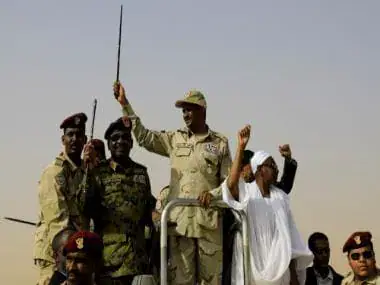
The Rapid Support Forces (RSF) is one of the two armed parties involved in the ongoing conflict in Sudan. Historically, the RSF has collaborated with various domestic and external actors, but recently, many have distanced themselves from the group. The RSF's institutionalization can be attributed to the convergence of goals between Sudan and the European Union (EU) in the 2010s. In 2003, during the Darfur war, the Sudanese Armed Forces (SAF) suffered a significant setback, leading the government to mobilize Darfurians, including Mohammad Hamdan Dagalo, also known as Hemedti, the current leader of the RSF.
The counterinsurgency campaign in Darfur was successful militarily but resulted in severe humanitarian consequences. The International Criminal Court (ICC) issued an arrest warrant for then-President Al-Basheer in 2009 for war crimes and crimes against humanity. Despite the reputational costs, the government admired the model of informal militias, which were later deployed outside Darfur and grew in size. In 2013, these militias were officially recognized as the RSF and attached to the National Intelligence and Security Service (NISS). The RSF was seen as a coup-proofing tool by many, given Al-Basheer's experience as an army officer who seized power through a military coup.
The RSF's growth was further facilitated by the government's efforts to address poverty and lift sanctions. In his 2014 "National Leap Speech," Al-Basheer outlined four prerequisites for Sudan's progress: peace, a free and rule-abiding political community, poverty alleviation, and the revival of the "Sudanese Identity." The EU, facing a migration crisis, established the Khartoum Process in 2014, a platform for cooperation with the Horn of Africa on migration routes. This initiative led to a marriage of convenience between the Sudanese government and the EU, with the latter seeking to address migration and the former aiming to achieve its "leap goals" through partnership with a global power.
To demonstrate its reliability as a partner, the Sudanese government drafted and amended several acts. The Asylum Regulating Act 2014 imposed restrictions on refugee movement, and the Sudan's Passports and Immigration Act 2015 made harboring aliens without residency permits a crime. The Combating of Human Trafficking Act 2014 defined various crimes related to human trafficking. These legislations aligned with the EU's goals and paved the way for the formalization of the RSF. In 2017, the Rapid Support Forces Act was passed, which included articles linked to previous legislations and amendments.
The RSF Act 2017 had significant implications, particularly in defining adversaries. While the Sudanese Armed Forces Act 2007 focused on foreign adversaries, insurgents, and gangs, the RSF's definition of an enemy extended to anyone operating outside the law and various criminal gangs. The Valletta Plan, which provided for the formalization and institutionalization of such powers, committed to establishing or upgrading national and regional anti-smuggling and anti-trafficking legislation. This plan effectively legitimized the RSF's role in Sudan's security landscape.
The EU's policies aimed to address migration, but they have inadvertently contributed to the growth and formalization of the RSF. The group's institutionalization has significant implications for Sudan's security and stability. As the conflict in Sudan continues, understanding the complex relationships between the RSF, the government, and external actors like the EU is crucial. The RSF's rise to prominence is a result of a convergence of interests between Sudan and the EU, which has led to a reevaluation of the group's role in the country's security landscape.
The formalization of the RSF has raised concerns about its impact on Sudan's stability and security. The group's leader, Hemedti, has become a key player in the country's politics, and the RSF's definition of an enemy has significant implications for civilians. As Sudan continues to navigate its complex security landscape, the international community must consider the unintended consequences of its policies and engage in a nuanced discussion about the RSF's role in the country.
Key points
- The EU's migration policies have contributed to the formalization of the RSF.
- The RSF's institutionalization has significant implications for Sudan's security and stability.
- The group's definition of an enemy extends to anyone operating outside the law and various criminal gangs.
Reporting sources
- Formalising the RSF: EU Policies and Sudan’s Search for Funds · African Arguments