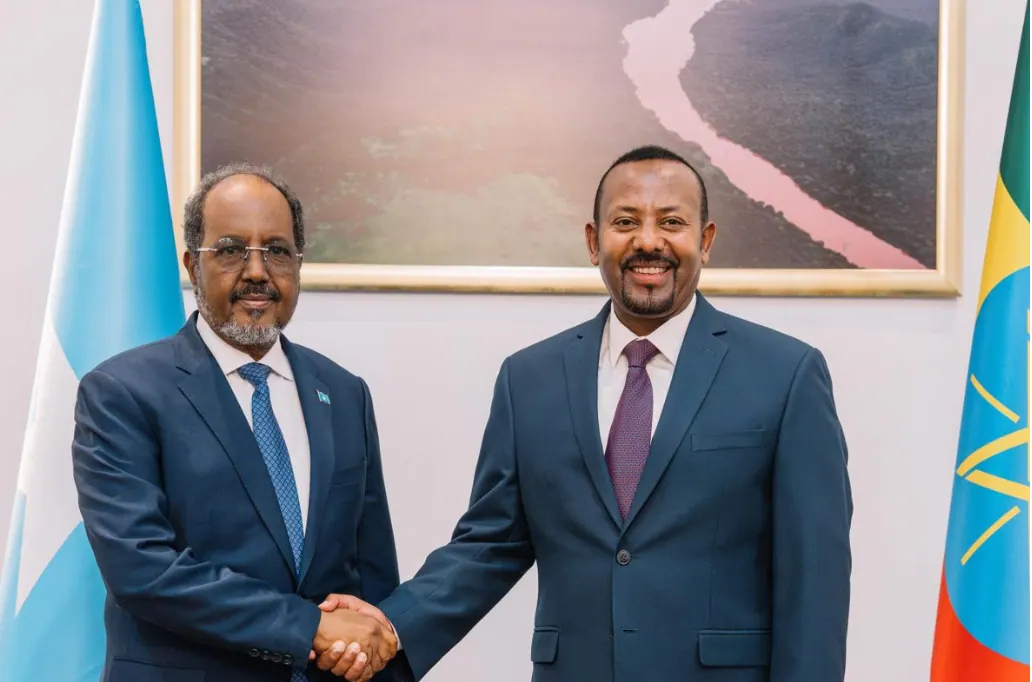
Ethiopia's state-run news agency, the Ethiopian News Agency (ENA), has launched a criticism against Somali President Hassan Sheikh Mohamud over his recent participation in a four-country summit held in Egypt's New Alamein on October 4. The summit brought together the leaders of Egypt, Somalia, Eritrea, and Sudan to discuss security, sovereignty, economic cooperation, and other regional issues. ENA's article focused on Hassan Sheikh's attendance at the summit and its implications for Ethiopia's strategic interests.
The summit ended with a joint declaration covering several sensitive issues in the Horn of Africa and the Red Sea. Among its provisions was a call for coastal states to retain responsibility for matters concerning the Red Sea, a position that could complicate Ethiopia's longstanding efforts to secure reliable access to maritime trade. The declaration also addressed the management of transboundary rivers, including the Nile, stressing adherence to international law and the principle of avoiding harm to other states.
ENA portrayed the provisions as potentially detrimental to Ethiopia's interests, particularly its plans for economic development, its position on Nile water resources, and its efforts to obtain access to the Red Sea. The agency questioned Hassan Sheikh's support for the summit declaration, presenting it as a shift in Somalia's relationship with Ethiopia. ENA recalled Ethiopia's involvement in Somali affairs over several decades, including its participation in reconciliation initiatives and conferences aimed at rebuilding Somalia's political institutions.
Ethiopia has played a significant role in Somalia's security operations, including its participation in successive African Union missions, such as AMISOM, ATMIS, and the current AUSSOM mission. The country has also been involved in peace processes, including the Sodere and Mbagathi initiatives. ENA's article highlighted these efforts, suggesting that Somalia's growing alignment with Egypt, Eritrea, and Sudan could conflict with Ethiopia's strategic interests.
The Nile issue is particularly sensitive for Ethiopia, Egypt, and Sudan. Addis Ababa is building the Grand Ethiopian Renaissance Dam on the Blue Nile and has defended the project as essential to its economic development and electricity generation. Egypt and Sudan have repeatedly called for arrangements they say would protect their downstream water interests. The New Alamein summit's position on transboundary rivers therefore adds another layer to already strained regional relations.
Somalia's participation in the summit comes amid a period of changing relations between Mogadishu and Addis Ababa. The two countries have previously cooperated closely on security, while disagreements over sovereignty, maritime access, and regional alliances have periodically strained ties. Hassan Sheikh has said Somalia is open to Ethiopia obtaining maritime access through Somali territory, but has stressed that any such arrangement must be negotiated between the two governments and respect Somalia's sovereignty.
The Ethiopian agency's criticism comes as tensions remain high across the Horn of Africa, where disputes involving Red Sea access, Nile waters, border security, and competing regional alliances increasingly overlap. While Addis Ababa has emphasized its desire to obtain maritime access through dialogue and mutually beneficial arrangements, Somalia and other coastal states have stressed sovereignty and the role of Red Sea littoral countries in determining the region's maritime affairs.
Key points
- Ethiopia's state-run news agency criticizes Somali President Hassan Sheikh Mohamud over his recent regional diplomacy.
- The New Alamein summit's position on transboundary rivers adds another layer to already strained regional relations.
- Somalia's participation in the summit comes amid a period of changing relations between Mogadishu and Addis Ababa.