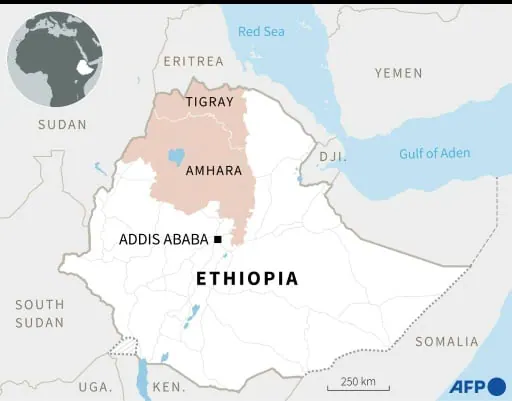
Renewed fighting between the Ethiopian government and Tigrayan rebels has led to a significant escalation in regional tensions. The conflict, which resumed last week, has been ongoing across several fronts in northern Ethiopia. Ethiopia and Eritrea have broken diplomatic ties, expelling each other's diplomats and shutting down their respective embassies. This development has raised concerns about the potential for further instability in the Horn of Africa.
The complex geopolitics of the region involve shifting alliances and the involvement of outside actors with conflicting interests. Eritrea, which gained independence from Ethiopia in 1993, has been accused by Ethiopia of backing the Tigray People's Liberation Front (TPLF) with troops. Eritrea has denied these allegations. The two countries have a history of conflict, including a brutal border war between 1998 and 2000. Relations improved with the rise of Ethiopia's Prime Minister Abiy Ahmed in 2018.
The Chatham House think tank has noted that Eritrea's priority is to keep war away from its own territory. However, the country's actions increase the risk of regional escalation. Eritrea's relations with Ethiopia have deteriorated, with Eritrea fearing that landlocked Ethiopia plans to invade and seize access to the Red Sea. The TPLF is believed to have supply lines secured through Tigray's northern border.
Sudan has close ties with the TPLF and Eritrea, with Tigrayan fighters reportedly fighting with the Sudanese Armed Forces (SAF) in Sudan's civil war. Ethiopia is accused of assisting the United Arab Emirates in supplying the Rapid Support Forces (RSF), which is fighting against the SAF. Sudan was accused of funnelling weapons and supplies to the TPLF during the last war. Clashes along the shared border in August suggest that this remains an active concern for the Ethiopian government.
Egypt has forged closer ties with Eritrea and Somalia in an apparent anti-Ethiopia front. Egypt is strongly opposed to Ethiopia's new Grand Ethiopian Renaissance Dam, which it says will affect downstream Nile waters. Ethiopia expelled an Egyptian diplomat on Thursday, without giving a reason. Cairo responded by expelling an Ethiopian diplomat.
The United Arab Emirates has invested deeply across east Africa, seeking security partnerships to counter rivals and control the Red Sea. The UAE has been one of Abiy's principal backers, giving him a $3 billion loan and investment package when he came to power in 2018. It has also provided military drones and logistical support during the last civil war. In return, it is alleged that Ethiopia has helped funnel arms to the UAE's allies in Sudan.
The United States was closely involved in the peace deal that ended the last civil war in 2022. However, its focus has lately been on the Red Sea and its efforts to contain Iran and its proxies. As a result, it allowed sanctions on Ethiopia and Eritrea to end, with the claim that the "national emergency... has expired". The US move has been seen as a significant development in the region.
Key points
- Ethiopia and Eritrea have broken diplomatic ties amid renewed fighting between the Ethiopian government and Tigrayan rebels.
- The conflict has raised concerns about regional instability and the potential for further escalation.
- The complex geopolitics of the Horn of Africa involve shifting alliances and the involvement of outside actors with conflicting interests.