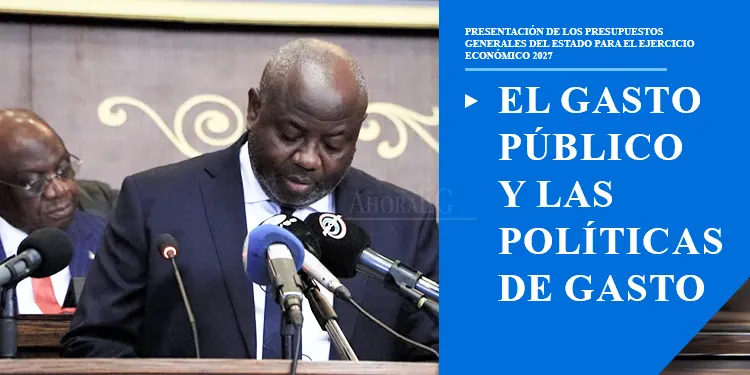
The government of Equatorial Guinea has unveiled its 2027 budget, which stands at 1.119.725 trillion FCFA. The budget allocates 875.700 billion FCFA for current expenditure and 244.025 billion FCFA for public investment. This financial plan aims to optimize public spending while ensuring essential services and social obligations are maintained. The budget reduction in current expenditure is part of a broader strategy to rationalize commitments that can be reviewed.
A key component of the 2027 budget is the enhancement of CONTFIN, a system designed to strengthen the authorization, registration, and monitoring of operations related to ministerial department expenditures and payments executed by the Autonomous Debt Amortization Fund. This upgrade is expected to improve the control of budgetary commitments and enhance the monitoring of execution. Furthermore, the implementation of the Treasury Single Account is set to provide a comprehensive view of the state's financial accounts and availability.
The Treasury Single Account is anticipated to improve payment programming, strengthen liquidity control, and mitigate the risk of commitments without financial coverage. This reform is part of a broader effort to enhance financial management and discipline in public spending. By centralizing financial information, the government aims to make more informed decisions about resource allocation.
The budget allocates 244.490 billion FCFA for personnel expenses and 344.741 billion FCFA for goods and services, which represents an 11% decrease. This reduction is aimed at optimizing resource utilization and eliminating redundancies and irregularities in the public payroll. The government is committed to reinforcing control over the public payroll and improving the efficiency of public spending.
Social spending remains a priority, accounting for 21.5% of the total budget, with 240.598 billion FCFA allocated. Education will receive 126.729 billion FCFA, including 7.000 billion FCFA for scholarships and 33.000 billion FCFA for the construction and rehabilitation of school centers. The health sector will be allocated 84.975 billion FCFA, with 20.400 billion FCFA dedicated to public health centers.
Public investment for 2027 is set at 244.025 billion FCFA, with a focus on sectors outside of oil, which will receive 161.075 billion FCFA. The investment strategy prioritizes projects that are already underway, social initiatives, and investments that can stimulate economic activity, create jobs, and improve public services. This approach aims to maximize the impact of public spending and achieve sustainable development.
The 2027 budget project links expenditure execution to enhanced control of financial commitments, more integrated management of public liquidity, and a more concentrated selection of investments. By implementing these financial tools and strategies, the government of Equatorial Guinea aims to improve the efficiency and transparency of public spending.
Key points
- The implementation of the Treasury Single Account and the enhancement of CONTFIN are central to Equatorial Guinea's strategy for improving public expenditure control.
- The 2027 budget prioritizes social spending, with significant allocations for education and health.
- Public investment will focus on sectors outside of oil, with an emphasis on projects that can generate economic activity and improve public services.