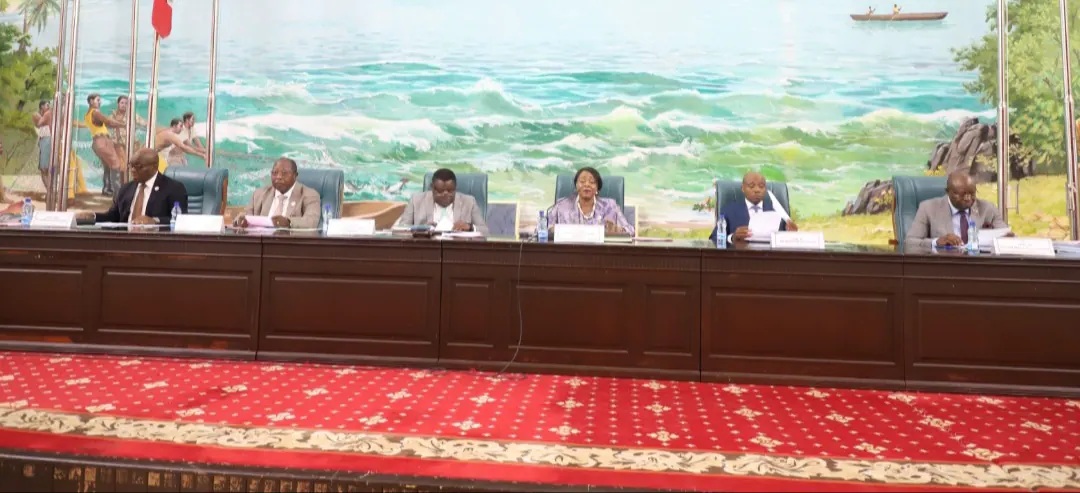
The Ministry of Hydrocarbons, Mines, and Electricity appeared before the Senate's Permanent Energy Commission on September 30 to discuss the strategic and economic framework of the 2026 Mining Law project. The session aimed to clarify technical, economic, and legal aspects of the project. Minister Delegate of Hydrocarbons Domingo Mba Esono addressed 18 thematic questions from senators, covering competitiveness, fiscal regime, social responsibility, and institutional architecture.
The minister argued that a new, comprehensive law is necessary due to the sector's complexity and transversality, ensuring legal security and enabling Equatorial Guinea to compete in international markets for capital and mining technology. The proposed law seeks to provide a fully integrated framework. Senators inquired about the project's main axes, including justification for a new law, social obligations during exploration, and royalty rates.
The Commission reviewed proposed royalty rates, ranging from 2% to 8%, assessing their competitiveness compared to neighboring CEMAC countries. Senators also questioned state participation, set at 10% for large-scale industrial mining and 15% for small and medium-scale mining. The Ministry clarified that new mining and geological registries and a Technical Processing Unit aim to digitalize and streamline administrative processes, reducing processing times to 90 days.
The Ministry addressed mechanisms for mineral traceability, insurance policy compatibility with CIMA regulations, administrative fees, and a preferential regime for critical minerals crucial to the global energy transition. The proposed law's framework will impact the country's mining sector and economy. A thorough examination of the project's aspects is essential for the Senate's decision-making process.
The Senate's review of the mining law project demonstrates the government's commitment to establishing a robust regulatory framework for the sector. The project's success will depend on balancing competing interests and ensuring a favorable business environment. Equatorial Guinea aims to attract investment and technology to develop its mining industry.
Key aspects of the proposed law include exemptions for operators from mandatory monetary charges during high-risk geological exploration phases. The Ministry and senators agreed on the need for a revised approach to social obligations during this phase. The project's implementation will require careful consideration of various stakeholders' interests.
The Senate's analysis of the mining law project will continue, with a focus on its potential impact on Equatorial Guinea's economy and mining sector. The government's efforts to establish a comprehensive regulatory framework will be crucial in shaping the country's mining industry.
Key points
- The Equatorial Guinea Senate reviews the 2026 Mining Law project with the Hydrocarbons Ministry to establish a comprehensive regulatory framework.
- The proposed law aims to provide legal security and enable Equatorial Guinea to compete in international markets for capital and mining technology.
- The project's framework will impact the country's mining sector and economy, with a focus on balancing competing interests and ensuring a favorable business environment.