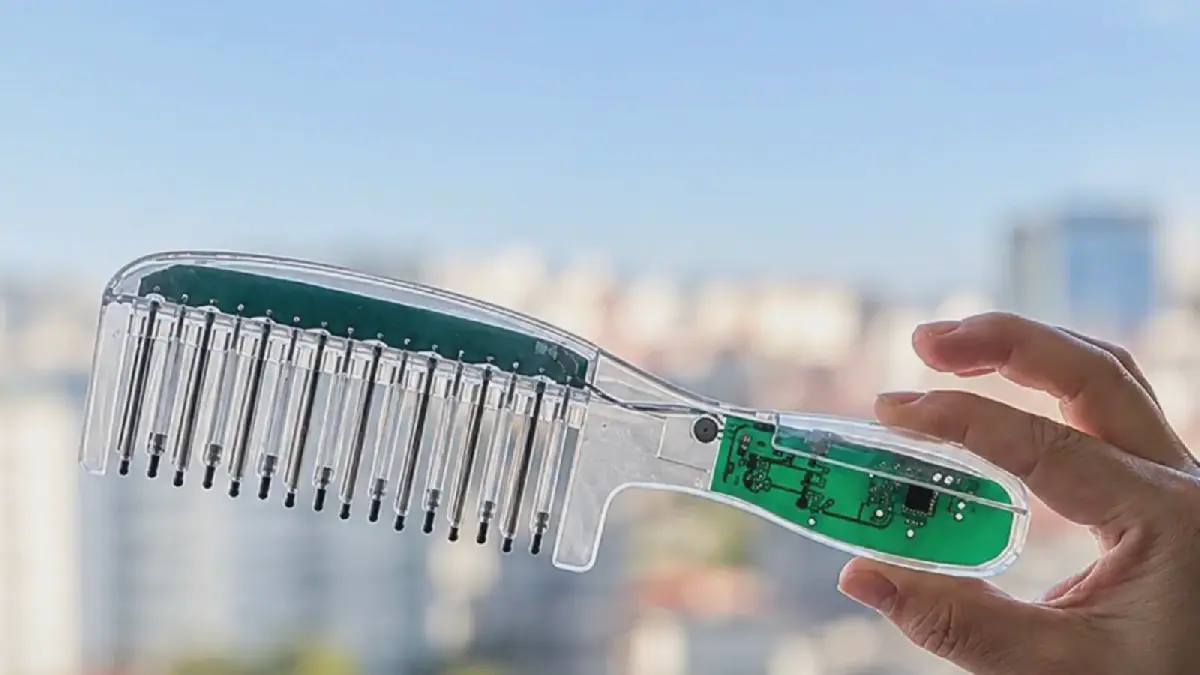
A team of researchers at Beihang University in Beijing has developed a bioelectronic comb called "Detangle" that uses electricity and experimental genetic treatments to encourage hair growth. In a 28-day experiment involving male mice with testosterone-induced hair loss, the device achieved approximately 97.85% regrowth when combined with two treatments. The findings, published on November 3 in Nature Communications, offer a promising approach to androgenetic alopecia, but do not establish that the device can restore hair in people.
The experiment involved using the Detangle comb with different treatment combinations to stimulate hair follicles and help therapeutic molecules penetrate the skin. Electrical stimulation combined with one experimental treatment, a VEGFA plasmid, produced about 90% regrowth, while pairing stimulation with another treatment, SRD5A2 siRNA, yielded approximately 85% regrowth. The strongest result came from combining electrical stimulation with both treatments. In comparison, untreated mice regrew about 1% of hair, while electrical stimulation alone produced approximately 40% regrowth.
The Detangle comb is designed to stimulate hair follicles and deliver therapeutic molecules deep into the skin, with the help of electroporation, which temporarily increases cell membrane permeability. The device's teeth contain electrodes of different heights and integrated modules for carrying therapeutic substances, creating a localized electric field. According to the researchers, this approach allows for delivery reaching up to approximately nine times deeper into hair-follicle regions than conventional external application.
The two experimental treatments used in the study have different jobs. The VEGFA plasmid carries genetic instructions for vascular endothelial growth factor A, a protein that promotes blood-vessel formation, while SRD5A2 siRNA is designed to reduce expression of the gene encoding steroid 5-alpha-reductase type 2, an enzyme implicated in the shrinking of susceptible follicles in pattern hair loss. Together, the approach seeks to support growth while interfering with a biological pathway associated with follicle miniaturization.
While the study's result is encouraging, it is essential to note that a shaved mouse back with experimentally induced hair loss is not equivalent to a human scalp that has been thinning for years. Differences in skin structure, follicle biology, and hair-growth cycles can affect whether an intervention translates successfully. Human studies would need to establish an appropriate dose, treatment schedule, and electrical exposure, as well as examine irritation, unwanted biological effects, and safety.
The study's findings do not validate commercially advertised electric combs or justify improvised electrical treatment. They also do not provide a reason to abandon prescribed medication. The achievement is narrower, but still significant: researchers have demonstrated a promising combination of electrical stimulation and molecular delivery in mice. However, it remains to be seen whether this combination can become a safe, affordable treatment for people.
For now, the practical message is caution rather than a shopping recommendation. Further research is needed to establish the safety and efficacy of the Detangle comb in humans. The study's lead author and team are likely to continue exploring the potential of their bioelectronic comb, but it is crucial to approach these findings with a critical and nuanced perspective, recognizing both the promise and the limitations of this innovative approach.
Key points
- The Detangle comb achieved 97.85% hair regrowth in mice with testosterone-induced hair loss.
- The device uses electrical stimulation and experimental genetic treatments to encourage hair growth.
- Human studies are needed to establish the safety and efficacy of the Detangle comb in people.
Reporting sources
- An electric comb offers hope for hair loss – so far, only in mice · weekendpost.co.bw