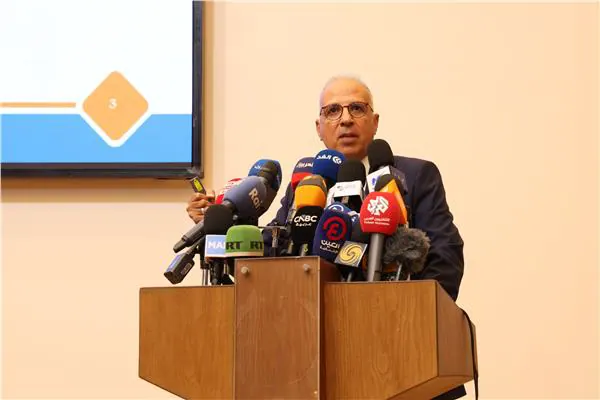
Egyptian Minister of Water Resources and Irrigation, Hani Suwelim, recently presented an overview of Ethiopia's vast water potential and its use of green and blue water. The presentation was part of a comprehensive briefing session organized by the Egyptian General Information Authority for regional and international media representatives. The session aimed to enhance direct communication with foreign media outlets and provide official data on water issues. Egypt's vision for managing water resources and cooperation in the Nile Basin was also discussed.
Minister Suwelim highlighted Egypt's unique water situation, emphasizing that over 98% of the country's renewable water resources come from outside its borders. He noted that Egypt's annual renewable water resources are approximately 56.80 billion cubic meters, while the country's water needs reach around 123 billion cubic meters per year. With a per capita share of renewable water resources of about 472 cubic meters per year, Egypt falls under the absolute water scarcity threshold of 500 cubic meters per capita per year.
The minister discussed Egypt's efforts to address these challenges, including the reuse of around 23.20 billion cubic meters of water per year. He also mentioned the national projects for treating agricultural wastewater, which have added a processing capacity of approximately 4.80 billion cubic meters per year. Additionally, Egypt is expanding its desalination plants, utilizing groundwater, and leveraging virtual water through food imports.
Minister Suwelim emphasized that desalination is a complementary component of Egypt's water management system but will not replace the Nile River's water. He outlined the second generation of Egypt's water management system, which focuses on transitioning to more intelligent, efficient, and flexible management. This includes expanding water treatment and reuse, automating monitoring and telemetering, and developing infrastructure.
The minister then presented an overview of the Nile Basin's water resources, noting that the basin receives around 2,000 billion cubic meters of rainfall per year. He highlighted that only about 84 billion cubic meters of this rainfall continues to flow through the Nile River to Aswan, accounting for around 4-5% of the basin's total rainfall. Minister Suwelim also addressed claims that Egypt receives the lion's share of the Nile's water, stating that Egypt's allocated share of 55.50 billion cubic meters represents only about 2.70% of the basin's total rainfall.
Minister Suwelim provided insights into Ethiopia's water resources, citing that the country received over 1,000 billion cubic meters of rainfall in 2023. He noted that around 467 billion cubic meters of this rainfall fell within the Ethiopian part of the Nile Basin. The minister also highlighted that Ethiopia's renewable water resources are estimated to be around 122 billion cubic meters per year. Additionally, he mentioned that Ethiopia has over 18 million hectares of agricultural land, compared to Egypt's 4.03 million hectares.
The minister emphasized that Ethiopia's development is not solely dependent on controlling the Blue Nile's water and that the country utilizes its water resources effectively. He noted that around 148 billion cubic meters of green water are used annually in Ethiopian agriculture, in addition to approximately 9.68 billion cubic meters of blue water used directly in agriculture. Minister Suwelim also highlighted Egypt's cooperation with Nile Basin countries, citing various projects aimed at supporting development in these countries.
Key points
- Egypt's water resources are limited, with over 98% of renewable water coming from outside its borders.
- Ethiopia has vast water potential, with over 1,000 billion cubic meters of rainfall in 2023.
- Egypt and Ethiopia are cooperating on water management and development projects in the Nile Basin.