Egyptian artist Nahla Morsi's work embodies a unique blend of artistic expressions, including visual arts, interior design, costume creation, and theater. Her experience highlights the idea that an artist can possess multiple creative sensitivities that complement and nourish a single artistic vision. Morsi's passion for portraiture, which she considers her "first love," is a central aspect of her career. Her interest in portraiture extends beyond physical reproduction, focusing on capturing emotions, expressions, and inner personality.
Morsi's approach to portraiture takes on a distinct dimension when representing artists, whose faces often convey a rich expressiveness tied to their work. She observes their expressions beyond the characters they portray, developing a deeper understanding of the relationship between image, light, and emotion. For Morsi, the theatrical stage is not just a technical space but a living organism that exists through the exchange between artists and the audience. Her experience as a theater decorator has profoundly influenced her artistic perspective.
Morsi's work in theater has allowed her to collaborate with numerous creators and actors, observing their expressions and developing a nuanced understanding of the interplay between image, light, and emotion. The importance of lighting is a common thread between her theatrical work and pictorial pieces. Inherited from her experience, Morsi explores a more personal dimension of her artistic expression. The large format of her canvases conveys the magnitude of the sentiment she aims to transmit.
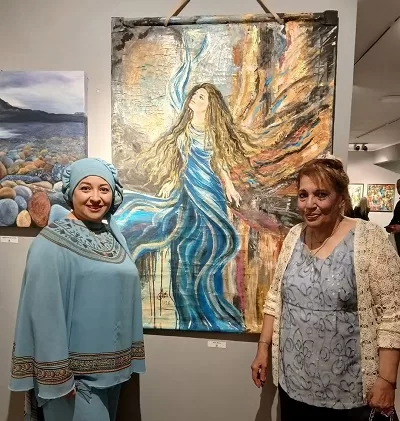
In her work "Liberté," presented in the "L'analphabétisme visuel" exhibition at the Diaa gallery, Morsi explores a more personal aspect of her artistic expression. The large canvas size reflects the intensity of the sentiment she seeks to convey, while the composition contrasts past forms, represented by hard and heavy lines, with a more fluid space associated with hope and renewal. Morsi's analysis of the song "Ya Wad Ya Taqil" from the film Khalli Balak Min Zouzou also reveals her perspective as a visual artist.
Morsi examines how lighting, staging, and visual composition contribute to constructing emotion. She views lighting not as a simple technical element but as a language that can convey meaning and atmosphere. This perspective is reflected in her paintings, where light becomes a narrative and emotional tool capable of revealing atmosphere and strengthening the presence of the represented character.
The intersection of Morsi's artistic experiences is evident in her work, where portraiture, theater, and light converge to form a personal creative identity. Her artistic vision is characterized by a deep understanding of the relationship between image, light, and emotion. Through her work, Morsi seeks to express the connection between the human experience and the artistic process.
Morsi's artistic journey serves as a testament to the power of interdisciplinary creative expression. Her work continues to evolve, exploring new dimensions of artistic storytelling and emotional resonance. As an artist, Morsi embodies the idea that creativity can manifest in multiple forms, each complementing and enriching the others.
Key points
- Nahla Morsi's artistic work combines visual arts, theater, and light to convey emotions and explore the human experience.