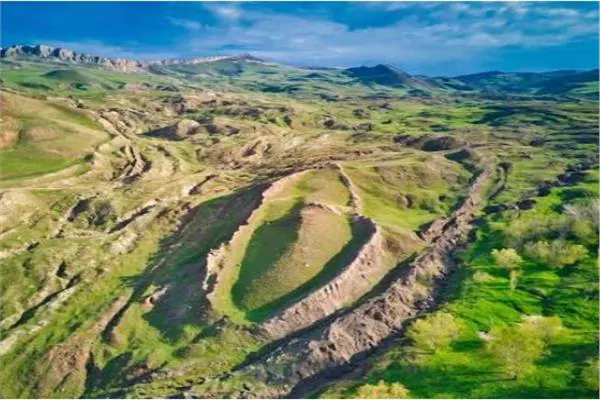
A peculiar rock formation in eastern Turkey, known as the Durupinar structure, has long fascinated researchers and explorers due to its striking resemblance to a giant ship. Located near Mount Ararat, the site measures approximately 157 to 164 meters in length and features a pointed and elongated shape, evoking comparisons to the biblical account of Noah's Ark. The formation's unusual appearance has sparked intense interest and speculation about its origins.
The site was first identified by Turkish military pilot Captain Ilhan Durupinar in 1959, who noticed its ship-like shape while examining aerial photographs. Since then, numerous attempts have been made to link the formation to the Ark described in the Book of Genesis, which is said to be approximately 300 cubits in length. While the similarity in shape and size is intriguing, it does not constitute conclusive evidence of an ancient ship.
Geologists have proposed alternative explanations for the formation's unique shape, suggesting that it may be the result of natural processes such as erosion, folding, and sedimentation. According to this theory, the combination of rocks, clay, limestone, and other geological factors could have created the distinctive shape. Previous investigations have failed to uncover conclusive archaeological evidence to support the claim that the site is an ancient ship.
A new research project, led by Professor Dr. Cengiz Atila from the Sivas Cumhuriyet University, has launched an extensive exploration of the site using advanced technologies. The team has employed ground-penetrating radar, electrical surveys, and lidar technology to map the formation's internal structure. The current phase of the project involves drilling and excavation efforts, which have reached depths of up to 18 meters.
The research team has also deployed a small robot, named Gopher, to explore and document the site's subsurface features. The robot is designed to access areas that are difficult for humans to reach and collect samples for further analysis. While the initial findings are promising, they do not provide conclusive evidence of an ancient ship.
The project's leaders emphasize that the primary objective is to document the site's geological features and subsurface structure, rather than to prove or disprove the biblical account. The analysis of samples collected during the excavation will be crucial in determining the site's origins and significance. The team's findings will contribute to a better understanding of the site and its potential connection to the legend of Noah's Ark.
The exploration of the Durupinar structure is an ongoing effort, with researchers working to uncover new insights into its geological and archaeological significance. As the project continues to unfold, it is likely to shed more light on the site's mysterious past and its potential connection to one of the world's most enduring legends. The scientific community eagerly awaits the results of the team's analysis, which will help to clarify the site's status and significance.
Key points
- The Turkish research team is using advanced technologies to explore the Durupinar structure and uncover its secrets.
- The site's resemblance to a ship has sparked debate about its connection to the biblical account of Noah's Ark.
- The project's findings will contribute to a better understanding of the site's geological and archaeological significance.