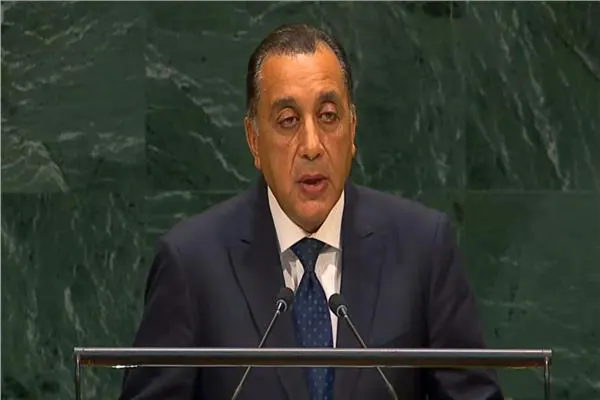
On September 25, 2026, Egyptian Prime Minister Dr. Mostafa Madbouly led the Egyptian delegation at the 81st UN General Assembly in New York, delivering a statement on behalf of President Abdel Fattah El-Sisi. He began by congratulating the President of the 81st UN General Assembly, Khalil Rahman, and UN Secretary-General António Guterres. Madbouly expressed Egypt's support for Rahman's leadership and confidence in his ability to successfully manage the session.
The Prime Minister highlighted that this year's General Assembly is themed "Restoring Trust, Managing Change," reflecting the challenges facing the international system. He noted that the world is changing rapidly, but international governance institutions are struggling to keep pace. Madbouly emphasized that the crisis lies not in the absence of principles and agreements but in the gap between rhetoric and action, and between decision-makers and those affected.
Madbouly stressed that the world needs effective multilateralism, where every country has a voice and every people have a fair share of decisions, opportunities, and resources. He lamented the decline of trust in collective action and the international system, citing the need to restore adherence to international law and avoid double standards and power politics. The Prime Minister emphasized that the Global South, representing the majority of the world's population, is disproportionately affected by the erosion of international law and global governance.
To restore trust, Madbouly proposed three interconnected pillars: just representation and decision-making, equal application of the law, and equitable distribution of development opportunities and resources. He emphasized that this is not a call to rebuild the international system from scratch but to fulfill its original promises: equal sovereignty, respect for the law, peaceful conflict resolution, and international cooperation for the benefit of all nations.
The Prime Minister pointed out that the Palestinian issue remains a critical test of the international system's credibility. He condemned the ongoing suffering and violations against the Palestinian people, stressing that a just solution is essential. Madbouly outlined Egypt's vision for a two-state solution, with an independent Palestinian state based on the 1967 borders, and emphasized the need for the international community to assume its responsibilities in protecting civilians and upholding international law.
Madbouly also highlighted Egypt's efforts to address regional crises, including the situation in Gaza. He emphasized the importance of a political solution, rejecting any attempts to displace the Palestinian people from their land. The Prime Minister stressed that Egypt will continue to work towards reconstruction and a viable political path, but success depends on the international community's will to translate legitimacy into decisive action.
Finally, Madbouly emphasized that Egypt's vision for regional security is based on state sovereignty, national institutions, and the rejection of external interference. He underscored that the country's water security is a vital issue, stressing that the Nile River is a lifeline for Egypt and that Cairo seeks cooperation and not conflict over shared water resources. The Prime Minister concluded by reaffirming Egypt's commitment to international cooperation, justice, and effective multilateralism.
Key points
- Egypt's Prime Minister calls for effective multilateralism and justice in global governance.
- The Prime Minister emphasizes the need to address the Palestinian issue as a critical test of the international system's credibility.
- Egypt stresses its commitment to regional security based on state sovereignty and national institutions.