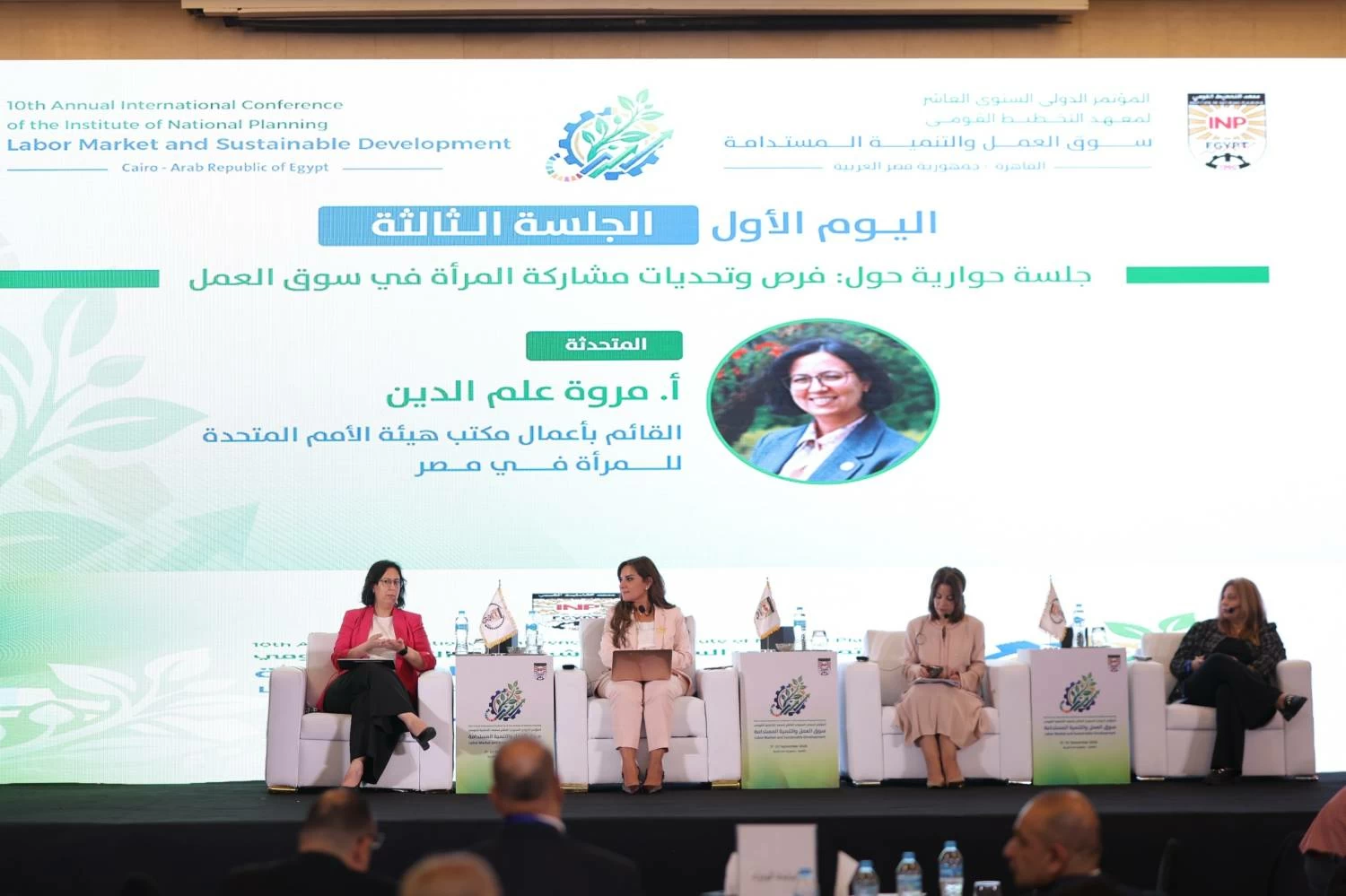
The National Planning Institute in Egypt recently hosted a high-level dialogue session titled "Opportunities and Challenges of Women's Participation in the Labor Market." The session was part of the 10th annual international conference of the National Planning Institute, themed "Labor Market and Sustainable Development." The event brought together prominent leaders and experts in women's economic empowerment and labor market issues.
Dr. Heba Magieb, who initiated the session, stated that the dialogue aimed to discuss the current state of Egyptian women's participation in the labor market and identify key challenges hindering their economic engagement. The session focused on factors influencing women's entry into and continuity in the labor market, including care economy, support services, financing, and work environment.
Dr. Hala El-Said, former Minister of Planning and Economic Development, emphasized that empowering women is not only a social value but also a significant economic one. She highlighted that increasing women's economic participation means leveraging a crucial part of human capital, converting women's skills and qualifications into added value and economic growth.
Dr. Marwa Elmogy, acting head of the UN Women office in Egypt, pointed out that investing in a fair and safe care system is a direct investment in the economy and society's ability to achieve more inclusive and sustainable growth. She noted that 84% of women in Egypt are involved in unpaid care work, compared to 34% of men, which limits women's ability to continue in the labor market and affects their education, career development, and economic independence.
Dr. Marian Qaldas, a member of the National Council for Women and the Egyptian Parliament, discussed the council's efforts to empower women, shifting from treating them as beneficiaries of support programs to active partners in development. The council has been working to qualify women to participate in the management of institutions through partnerships with the Egyptian Managers Center and the International Finance Corporation.
Engie El-Yamani, executive director of the Fund for Supporting Rural and Environmental Industries at the Ministry of Social Solidarity, explained that the fund adopts an approach that goes beyond direct financing to building comprehensive paths that ensure income and project sustainability. She emphasized the importance of partnerships in implementing integrated initiatives, citing the "Tahwisha" model and the "Rabha" program for employment and entrepreneurship.
The session concluded that the main challenges to Egyptian women's participation in the labor market include the gap between their educational and scientific excellence and their economic participation, which does not exceed 20%. The session emphasized the need for integrated systems for economic empowerment that combine financing, technical support, training, and connecting projects to markets and value chains.
Key points
- Only 20% of Egyptian women participate in the labor market.