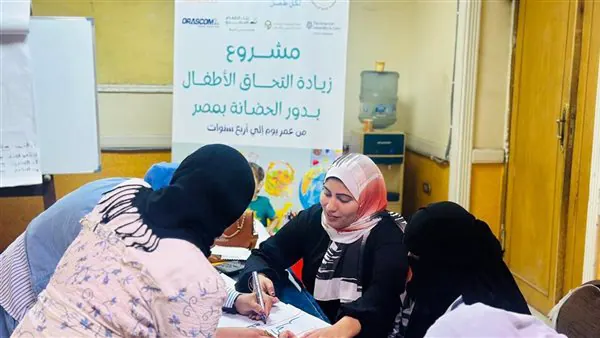
The Egyptian Ministry of Social Solidarity, in collaboration with UNICEF, has launched a project to increase the enrollment of children aged 0-4 in nurseries. As part of this initiative, 75 facilitators were trained in the governorates of Beni Suef, Minya, and Asyut on the application of an awareness guide and the modification of negative customs and concepts. The training included practical activities and applications to help parents acquire skills that can be applied in daily life, enhancing children's capabilities and developing their linguistic, social, and emotional skills.
The project also implemented 269 awareness sessions for parents in the participating governorates, conducted by trained facilitators. These sessions covered important topics such as positive parenting, balanced upbringing, and the importance of effective communication between the family and nursery. The goal is to promote partnership between the family and nursery in supporting the child's growth and meeting their diverse needs. By empowering parents and caregivers with the necessary knowledge and skills, the project aims to create a supportive environment for early childhood development.
The project focuses on building the capacities of nursery workers and enhancing their ability to apply quality standards and training packages for early childhood development. Several training programs were conducted for nursery service providers, including members of management boards, nursery directors, facilitators, and childcare workers. These programs aimed to unify concepts and practices related to the quality of care provided to children, ensuring that they receive the best possible start in life.
During this phase, approximately 208 trainees were trained on the national quality standards document for nurseries. Additionally, facilitators and directors were trained on the basic and advanced training guides for nursery facilitators and the updated guide for nursery caregivers. These training programs are designed to ensure that nursery workers have the necessary skills and knowledge to provide high-quality care and education to young children.
According to Hanane Mustafa, Head of the Central Administration for Family and Women's Affairs, investing in early childhood development is a vital investment in Egypt's future. She emphasized the ministry's commitment to continuing training and awareness programs for nursery service providers and families, aiming to improve the quality of services provided to children and create a safe and stimulating educational environment.
The training and awareness sessions are part of a broader effort to promote societal awareness of the importance of early childhood development and support caregivers and parents with the necessary knowledge and skills. By providing children with a nurturing environment, families and caregivers can help build their personalities, develop their abilities, and enhance their growth in a healthy and supportive setting.
These initiatives align with the Egyptian government's focus on investing in human capital, improving the quality of services provided to vulnerable groups, and supporting the goals of sustainable development and Egypt's Vision 2030. By prioritizing early childhood development, the government aims to prepare future generations to learn, innovate, and contribute effectively to the country's development.
Key points
- The Egyptian Ministry of Social Solidarity has trained 75 facilitators and conducted 269 awareness sessions to support early childhood development in three governorates.
- The project aims to increase the enrollment of children aged 0-4 in nurseries and promote partnership between families and nurseries in supporting children's growth.
- The initiatives align with the Egyptian government's focus on investing in human capital and supporting sustainable development goals.