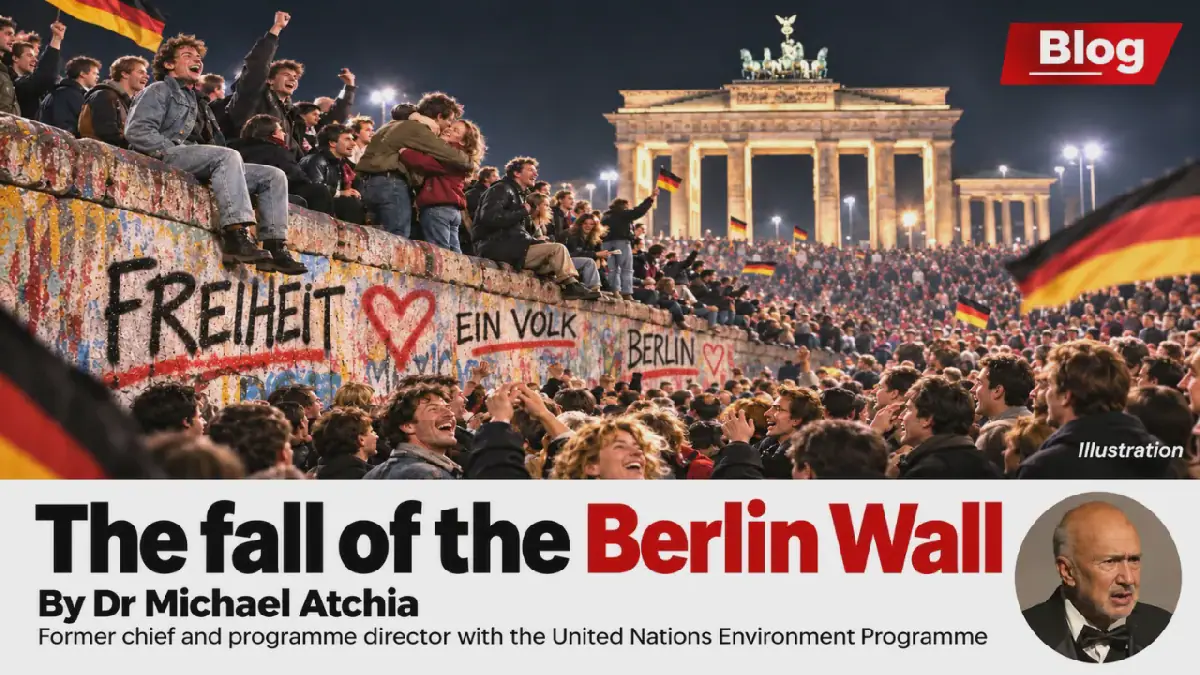
Dr. Michael Atchia, a former chief and program director with the United Nations Environment Programme (UNEP), has shared his personal account of the fall of the Berlin Wall, which took place on November 8-9, 1989. As a participant in the demolition of the wall, Dr. Atchia described the event as "taking part in history-making." His involvement with the UNEP's Dresden Course, a joint program with UNESCO and the East German government, led to his frequent visits to East Berlin and Dresden between 1986 and 1989.
During his visits to East Germany, Dr. Atchia observed a series of subtle but significant changes in the society. He noted that the government's control was slowly loosening, and people were increasingly discussing the future and planning escapes to the West. As a foreign UN official, Dr. Atchia maintained his professional neutrality while providing information and advice when needed. In March 1989, he gave an interview to an East German newspaper, Neue Zeit, highlighting the need for accurate statistics on air, land, and water quality in the country.
On the evening of November 8, 1989, Dr. Atchia joined his German colleagues, including Kathrin and Sabena, on Unter den Linden, the broad avenue leading to the Brandenburg Gate. Hundreds of thousands of people had gathered, and Dr. Atchia decided to join them, changing into a black leather jacket and thick scarf. The crowd was composed of Germans from all age groups and professions, with a notable absence of older state officials and foreigners, except for Dr. Atchia.
As the crowd approached the Berlin Wall, the armed guards did not know how to react, and eventually, they laid down their arms. Some guards even removed their uniforms, allowing the crowd to access the no man's land surrounding the wall. Using various tools, the crowd began to break the wall, and Dr. Atchia joined in, feeling a sense of commitment and unity with the crowd.
The next day, the demolition of the wall continued, and many East Germans who crossed into the West returned home, expressing a desire for freedom but not the materialistic lifestyle of the West. Dr. Atchia kept a brick from the wall as a souvenir, but he emphasized that the true achievement of those days was not measured in concrete and bricks but in the hearts of people.
The fall of the Berlin Wall marked the beginning of the end of the Soviet Union and the collapse of totalitarian communism. Dr. Atchia reflected on the significance of the event, stating that it was the end of an era and almost the end of the 20th century, which saw 100 million people killed in 50 wars, including two world wars.
Dr. Atchia's account of the fall of the Berlin Wall serves as a personal and historical reflection on the event's significance. He noted that the event was a work of immense construction, not just demolition, and that it paved the way for a new era of freedom and unity.
Key points
- Dr. Michael Atchia participated in the demolition of the Berlin Wall on November 8-9, 1989, as a UNEP official.
- The fall of the Berlin Wall marked the beginning of the end of the Soviet Union and the collapse of totalitarian communism.
- Dr. Atchia's experience during the event was influenced by his work with the UNEP's Dresden Course and his observations of the changes in East German society.
Reporting sources
- [Blog] The fall of the Berlin Wall · Le Défi Plus