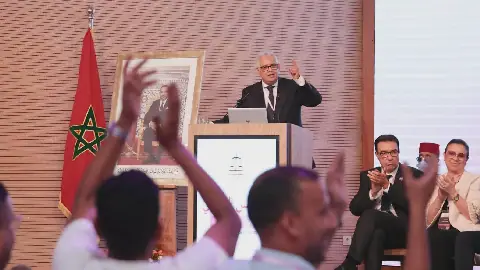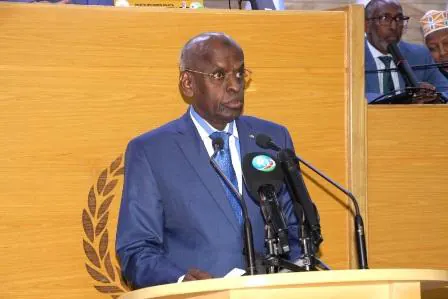
The National Assembly of Djibouti convened its second ordinary session for 2026, chaired by Speaker Dlieta Mohamed Dlieta, with Prime Minister Abdoulkader Kamil Mohamed in attendance. The session aims to discuss the 2027 budget and financial policies. The Prime Minister outlined the government's economic and financial plans, emphasizing cautious estimates due to global and regional risks. The 2027 budget prioritizes fiscal discipline, transparency, and efficient spending.
The 2027 budget projects a 7% growth in GDP, with total revenues estimated at 161.3 billion Djiboutian francs and total expenditures at 160.5 billion Djiboutian francs, resulting in a limited surplus. The government expects a 14% increase in tax revenues, driven by improved tax collection efforts. Non-tax revenues are projected to decline from 54.7 billion francs in 2026 to 44.6 billion francs in 2027.
The government's economic strategy focuses on four main axes: economic growth and diversification, human capital and social cohesion, governance and accountability, and environmental transition and climate resilience. A new task force will address short-term issues requiring rapid government response. The Prime Minister emphasized the importance of effective coordination among ministries and enhanced transparency and accountability in governance.
The 2027 budget includes a significant increase in capital expenditures, rising to 54.7 billion Djiboutian francs, up 45% from 2026. These expenditures will be financed through external resources and domestic funding. The government aims to enhance project selection mechanisms, linking allocated resources to measurable objectives and indicators.
The Prime Minister highlighted several strategic projects aimed at strengthening Djibouti's position as a regional hub for transportation, logistics, trade, and energy. These projects include a new airport in the Biidley area and an energy infrastructure project in Doraleh, featuring a product storage facility and a 120-kilometer pipeline to Ethiopia.
The government is working to diversify the economy, focusing on sectors such as light industries, digital economy, tourism, fishing, and renewable energy. The Prime Minister stressed the importance of supporting entrepreneurship, particularly among youth and women, and promoting private investment. The government aims to improve the business environment by enhancing infrastructure, security, and digitization.
The government will continue to reform public finance management, modernizing budgetary processes and improving financial analysis. The digitization of public finance will continue, with a shift towards electronic documents and enhanced transparency. The government will prioritize human capital development, focusing on education, vocational training, and healthcare.
Key points
- The 2027 budget prioritizes fiscal discipline and transparency.
- The government aims to enhance project selection mechanisms and improve coordination among ministries.
- Djibouti is investing in strategic projects to strengthen its position as a regional hub.