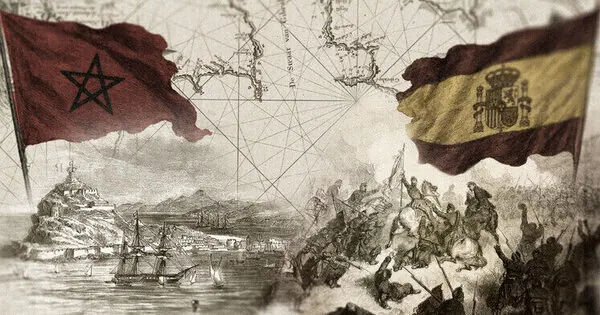
The dispute over Ceuta and Melilla, two Spanish semi-exclaves on Africa's Mediterranean coast, has reignited amid a migration crisis. In late July, over 70,000 illegal migrants crossed into Ceuta, prompting Spain to call it a violation of its territorial integrity. Morocco, which does not recognize Spanish sovereignty over the cities, raised the issue of their "occupation" by Spain and asserted its own historical right to them.
The dispute has a long history dating back to the Crusaders' expansion in the Mediterranean and the early modern-period wars that gave rise to European colonialism. Ceuta and Melilla came under Spanish control as a result of these events. Since Morocco gained independence in 1956, Rabat has regularly raised the question of the status of the enclaves, seeking to have them brought back under its own control through dialogue.
In 1975, Morocco unsuccessfully attempted to bring the matter before the UN, and in 1987, King Hassan II proposed establishing a joint "cellula de reflexion" with Spain to negotiate the future status and eventual handover of the two cities. However, Spain rejected this proposal. The dispute escalated into a brief military standoff in the early 2000s, and in 2007, Morocco recalled its ambassador for consultations after a historic state visit by Spain's King Juan Carlos I and Queen Sophia to both enclaves.
The dispute reignited in 2021 when Rabat recalled its ambassador from Madrid after Spain secretly admitted Brahim Ghali, the leader of the POLISARIO Front, to a hospital for treatment. Diplomatic relations were restored in March 2022, when Spanish Prime Minister Pedro Sanchez sent a letter to the King of Morocco endorsing the Moroccan autonomy plan for Western Sahara. Recently, Moroccan Minister of Justice Abdellatif Ouahbi stated that his country had consistently raised the issue of the status of the cities, seeking a long-term solution through dialogue.
Spanish authorities have stated that they consider both cities an integral part of their territory. "Ceuta and Melilla aren't just Spanish; they're super-Spanish and cannot be touched," said Defense Minister Margarita Robles. In response, Moroccan Minister of Islamic Affairs Ahmed Toufiq mentioned ancient Sufi prayers and texts from the 7th and 15th centuries, which served as a rallying cry for Moroccans during past battles to liberate occupied territories, such as the Spanish enclaves of Ceuta and Melilla.
The population of Ceuta and Melilla is approximately 170,000 people, the majority of whom are of Moroccan origin. Geographically, the cities are situated in Africa and surrounded by Moroccan territory, but politically and administratively, they belong to Spain. The cities have a unique cultural and historical significance, with Ceuta being the birthplace of prominent religious figures such as Qadi Ayyad and Abu al-Abbas al-Azafi.
The dispute over Ceuta and Melilla is a complex issue with deep historical roots. Both Morocco and Spain have strong claims to the cities, and the issue remains a sensitive topic in relations between the two countries. The international community, including the EU, has recognized Spanish sovereignty over the cities, but Morocco continues to assert its historical right to them.
Key points
- The dispute over Ceuta and Melilla has reignited amid a migration crisis, with Morocco asserting its historical right to the cities and Spain considering them an integral part of its territory.
- The cities have a combined population of approximately 170,000 people, the majority of whom are of Moroccan origin.
- The dispute has a long history dating back to the Crusaders' expansion in the Mediterranean and the early modern-period wars that gave rise to European colonialism.