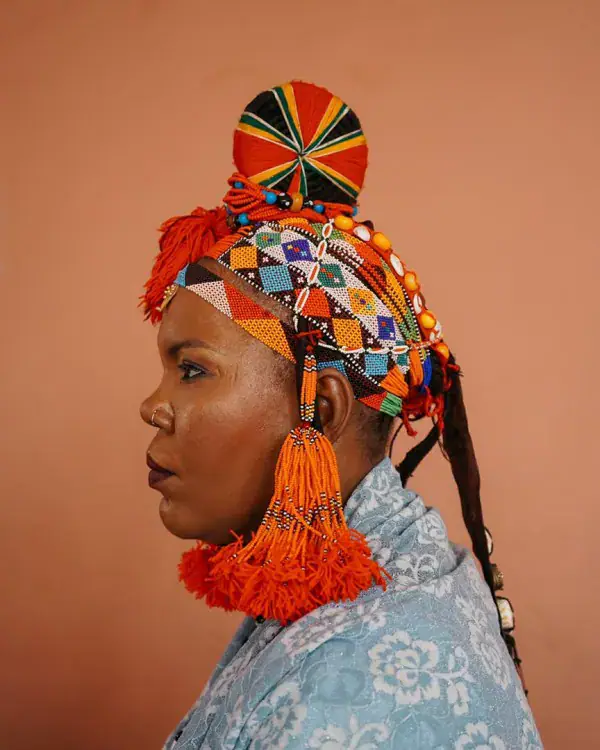
In the Sonrhaï community of northern Mali, traditional braids are an integral part of cultural and social identity. Each stage of a woman's life is marked by specific hairstyles, from birth to old age. These braids not only signify a woman's status but also showcase the artistic prowess of the Songhoy people. According to Maïga Farimata Touré, a trainee secretary at the Gao Sahel Museum, Songhoy braids are created based on local culture, ethnic identity, events, and personal desires.
Songhoy braids are diverse and categorized into three main types: pre-pubescent braids, beauty braids, and forbidden braids. Before reaching puberty, young girls wear the "Jisi" braid, characterized by a shaved head with a thin strip of hair from left to right. As they grow older, they adopt the "Tchiéchi" braid, signifying their transition to adolescence. This braid is typically worn with a white boubou, black pagne, and animal skin shoes. The "Sourgou-sourgou" braid is reserved for girls aged 13 and above.
Beauty braids, such as "Zourazoura" and "Zoota-kamba," are worn by young women during festivals and signify their marital status. The "Kokara" braid, adorned with beads, indicates motherhood and conveys messages about the child's gender based on the number of beads worn on the forehead. For instance, three beads signify a male child, while four beads signify a female child. These braids are not only aesthetically pleasing but also carry significant cultural meaning.
Married women who have given birth twice wear the "Zumbu" braid, resembling a rooster's crest, with hair braided on all sides and adorned with beads and red threads. The "Yolo-Gorbo" braid, characterized by divided and braided hair, is a complex design worn by some women. In contrast, the "Bamba-Bamba" braid, featuring beads on the forehead, is worn by newlywed women and is forbidden for widows and unmarried women.
Certain braids are reserved for specific age groups or marital statuses. The "Moorari" braid, meaning "caress" in Songhoy, is exclusive to post-menopausal women. The "Binda" braid is forbidden to men who may marry the wearer after a four-month and ten-day period following her widowhood. The "Faata" braid is prohibited for women, while the "Hilo Hilo" braid was traditionally worn by women from the Gorongobou ethnic group in Gao.
According to Abdoulaye Boncona Maïga, director of the Gao Sahel Museum, Songhoy braids play a significant role in social bonding and knowledge transmission. The braids allow women to share moments of joy and sorrow, and their creation involves a long process of learning and skill transfer between generations. Maïga Mariam Maïga, a descendant of the Songhoy ethnic group, expresses pride in her heritage but questions the relevance of certain traditional prohibitions.
Halimatou Touré, known as Halibara, is a guardian of Songhoy braids and has inherited her skills from her grandmother. She has gained recognition in Mali and beyond for her expertise and now trains young girls in the art of traditional braiding. Through initiatives like these, the cultural significance and beauty of Songhoy braids can be preserved and passed down to future generations.
Key points
- Songhoy braids convey a woman's age, marital status, and life events through intricate designs and adornments.
- The braids are categorized into pre-pubescent, beauty, and forbidden braids, each with its unique significance and cultural context.
- Songhoy braids play a significant role in social bonding, knowledge transmission, and cultural identity in the Sonrhaï community of northern Mali.