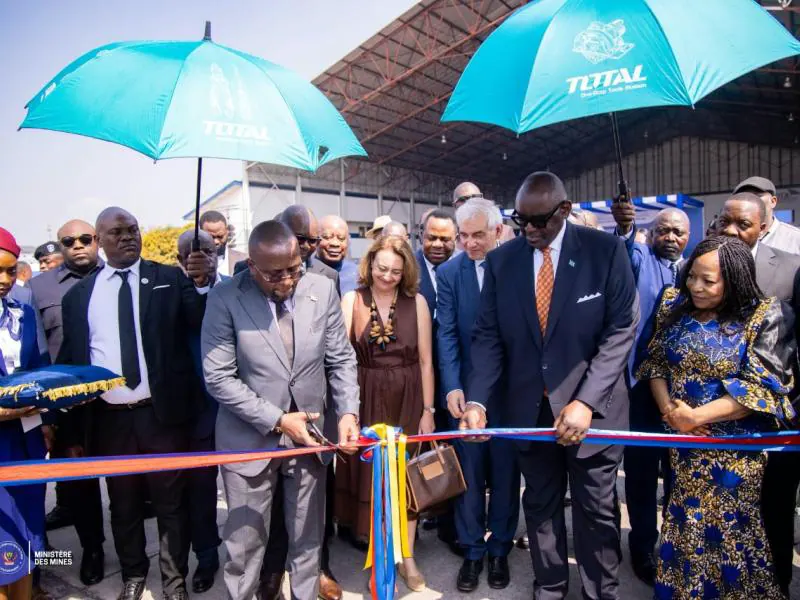
The Democratic Republic of Congo officially launched the Programme de Cartographie Géophysique Aéroportée et Géologique de la RDC (PC2G-RDC) on October 5, 2026, at Ndolo Airport in Kinshasa. The program aims to strengthen the country's knowledge of its geological and mineral potential using high-precision geophysical and geological data. The launch ceremony was attended by several dignitaries, including the Vice Prime Minister and Minister of the Interior, Jacquemain Shabani, and the Minister of Mines, Louis Watum Kabamba.
The PC2G-RDC program is a technical initiative led by the Service Géologique National du Congo (SGN-C), which is under the Ministry of Mines. The program is funded by the Fonds Minier pour les Générations Futures (FOMIN) and implemented by the Spanish firm Xcalibur Multiphysics Group SL. The program's primary goal is to improve the exploration and valorization of the country's natural resources by reducing uncertainties and enabling the state to make informed decisions based on reliable scientific data.
According to Minister of Mines Louis Watum Kabamba, the Democratic Republic of Congo's mineral heritage is exceptional, but less than 10% of its territory has been thoroughly explored. He emphasized that the program is a strategic investment in the country's future, enabling it to better understand its territory, master its mineral heritage, and transform this knowledge into development opportunities for the Congolese people.
The program will focus on acquiring high-resolution geophysical data using advanced technologies such as magnetometry, gravimetry, and radiometry. These data will be combined with geological and geochemical information to improve the understanding of the country's subsurface. The program also aims to transfer skills and knowledge to Congolese geologists, researchers, technicians, and students.
Raoul Wazenga Vitima, Director General of the Service Géologique National du Congo (SGN-C), highlighted the importance of the program in improving the state's knowledge of its subsurface. He explained that the program will enable the state to make informed decisions about concession, evaluation, and valorization of its mineral resources.
The program is expected to increase the country's geoscientific coverage from 22.27% to 46.1%. According to Minister Watum Kabamba, this will not only improve the state's knowledge of its mineral heritage but also enable investors to better assess opportunities and create jobs.
The launch of the PC2G-RDC program marks a significant step in the Democratic Republic of Congo's efforts to harness its mineral resources for economic development. The program is expected to have a positive impact on the country's mining sector and contribute to the improvement of the living standards of the Congolese people.
Key points
- The Democratic Republic of Congo has launched a program to explore and valorize its mineral resources using scientific data.
- The program aims to increase the country's geoscientific coverage from 22.27% to 46.1%.
- The program will improve the state's knowledge of its subsurface and enable informed decisions about concession, evaluation, and valorization of its mineral resources.