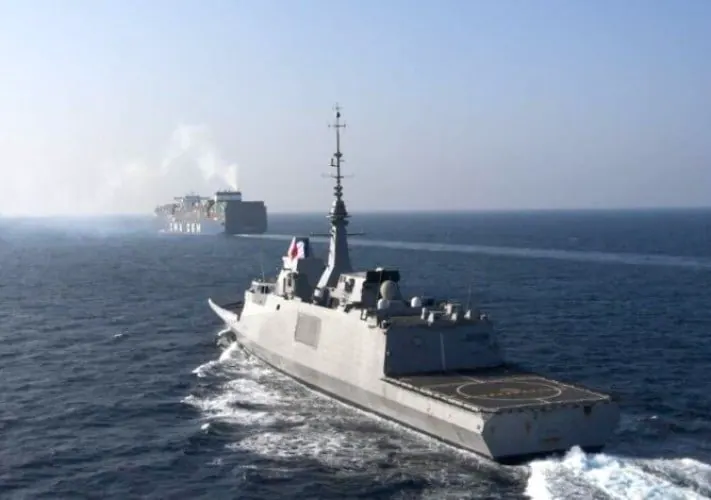
Commercial ships are currently lined up awaiting maritime protection to cross the southern Red Sea. The European Union has acknowledged that its "Aspides" mission does not have enough warships to meet this demand. EU foreign policy chief Kaya Kallas made this admission after a meeting of EU defense ministers in Brussels on Monday. She stated that there are commercial ships waiting in line for protection.
The EU's Aspides mission was launched in 2024 as a defensive operation to protect commercial shipping from Houthi attacks. Italy and Greece have provided the core ships for the mission, with Germany, France, Spain, the Netherlands, and Belgium periodically reinforcing the deployment. However, Kallas revealed that initial estimates for the mission indicated a need for at least 10 ships, but the available resources are significantly lower than that level.
The security environment has become increasingly challenging, particularly with the resurgence of Houthi activities and their control of areas overlooking the Bab al-Mandab Strait, including the island of "Brim". This has exacerbated the shortage of resources. Kallas noted that two EU states have expressed willingness to provide additional ships, but Brussels is specifically seeking frigates and enhanced air defense capabilities, not just extra vessels.
Container ships, in particular, have returned in large numbers to the Suez Canal route. According to shipping consultancy Linerlytica, over 140 container ships with a total capacity of more than 2 million twenty-foot equivalent units (TEU) have rejoined this route since May. Last week saw the highest rate of container ship traffic through the Suez Canal since 2024, with 30 ships with capacities exceeding 4,000 TEU crossing the canal.
The increased demand for maritime protection comes as Italy prepares to act independently, rather than waiting for Aspides mission arrangements. Earlier this month, it was reported that around 10 Italian-flagged or affiliated ships were waiting for protected passage. The development highlights the challenges faced by the EU in providing adequate protection for commercial shipping in the region.
EU foreign policy chief Kaya Kallas emphasized that the bloc is working to address the shortage of resources. She noted that the current situation requires more than just additional ships, but also enhanced capabilities. The EU is seeking to bolster its maritime protection efforts, but the process is likely to take time.
The situation in the Red Sea remains complex, with commercial shipping facing increased risks. The EU's Aspides mission has been working to mitigate these risks, but the shortage of resources is a significant challenge. The bloc is exploring options to enhance its maritime protection capabilities and address the growing demand for protected passage.
Key points
- The EU's Aspides mission lacks sufficient warships to meet demand for maritime protection in the Red Sea.
- Commercial shipping has seen a significant increase in traffic through the Suez Canal, with over 140 container ships returning to the route since May.
- The EU is seeking to bolster its maritime protection efforts, including enhanced air defense capabilities and frigates.